
Join Our JEE Preparation Group
Prep with like-minded aspirants; Get access to free daily tests and study material.
Sign in
Please select an account to continue using cracku.in
↓ →
Join Our JEE Preparation Group
Prep with like-minded aspirants; Get access to free daily tests and study material.
Two infinite identical charged sheets and a charged spherical body of charge density '$$\rho$$' are arranged as shown in figure. Then the correct relation between the electrical fields at A, B, C and D points is:
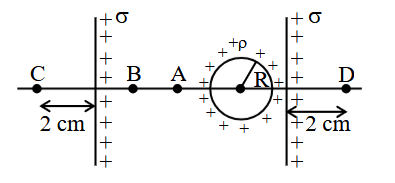
Field due to one infinite positively charged sheet is
$$E=\frac{\sigma}{2\varepsilon_0}$$
directed away from the sheet.
There are two identical positive sheets.
At points A and B, which lie between the sheets:
Magnitudes are equal, so they cancel.
So between the sheets only the charged sphere contributes.
Outside a uniformly charged sphere,
$$E\propto\frac{1}{r^2}$$
Point A is closer to the sphere than BBB, hence
$$E_A>E_B$$
Now point C:
It lies outside both sheets.
Both sheet fields point left and add:
$$E_{\text{sheets}}=\frac{\sigma}{\varepsilon_0}$$
Sphere field at C also points left, so it adds.
Thus
$$E_C=\frac{\sigma}{\varepsilon_0}+E_{\text{sphere at C}}$$At point D:
Again sheet contribution is
$$\frac{\sigma}{\varepsilon_0}$$
Sphere field also adds.
But D is closer to the sphere than C, so
$$E_{\text{sphere at D}}>E_{\text{sphere at C}}$$
Therefore
$$E_D>E_C$$
Was this solution helpful?
Create a FREE account and get:
_1.webp)

Educational materials for JEE preparation

Ask our AI anything

AI can make mistakes. Please verify important information.
AI can make mistakes. Please verify important information.
