
Join Our JEE Preparation Group
Prep with like-minded aspirants; Get access to free daily tests and study material.
Sign in
Please select an account to continue using cracku.in
↓ →
Join Our JEE Preparation Group
Prep with like-minded aspirants; Get access to free daily tests and study material.
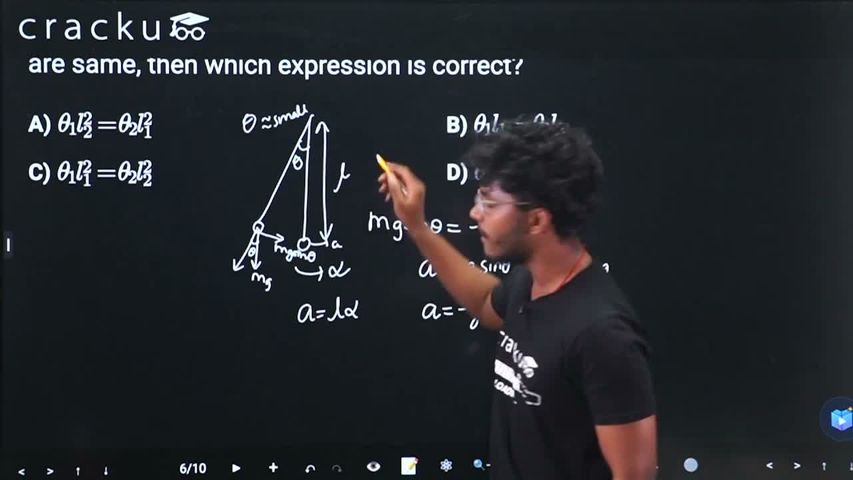
Two simple pendulums having lengths $$l_1$$ and $$l_2$$ with negligible string mass undergo angular displacements $$\theta_1$$ and $$\theta_2$$, from their mean positions, respectively. If the angular accelerations of both pendulums are same, then which expression is correct?
For a simple pendulum executing small-angle oscillations, the restoring torque gives the angular equation of motion
$$\alpha = -\frac{g}{l}\,\theta$$
where $$\alpha$$ is the angular acceleration, $$g$$ is the acceleration due to gravity and $$l$$ is the length of the pendulum.
Case 1: First pendulum
Length $$= l_1$$, angular displacement $$= \theta_1$$
Therefore
$$\alpha_1 = -\frac{g}{l_1}\,\theta_1$$ $$-(1)$$
Case 2: Second pendulum
Length $$= l_2$$, angular displacement $$= \theta_2$$
Therefore
$$\alpha_2 = -\frac{g}{l_2}\,\theta_2$$ $$-(2)$$
The question states that both pendulums have the same angular acceleration, so
$$\alpha_1 = \alpha_2$$ $$-(3)$$
Substituting $$(1)$$ and $$(2)$$ into $$(3)$$:
$$-\frac{g}{l_1}\,\theta_1 = -\frac{g}{l_2}\,\theta_2$$
The factor $$-g$$ is common on both sides and cancels out, giving
$$\frac{\theta_1}{l_1} = \frac{\theta_2}{l_2}$$
Cross-multiplying, we obtain the required relation
$$\theta_1\,l_2 = \theta_2\,l_1$$
This matches Option D.
Answer : Option D
Was this solution helpful?
Click on the Email ☝️ to Watch the Video Solution
Create a FREE account and get:
_1.webp)

Educational materials for JEE preparation

Ask our AI anything

AI can make mistakes. Please verify important information.
AI can make mistakes. Please verify important information.
