
Join Our JEE Preparation Group
Prep with like-minded aspirants; Get access to free daily tests and study material.
Sign in
Please select an account to continue using cracku.in
↓ →
Join Our JEE Preparation Group
Prep with like-minded aspirants; Get access to free daily tests and study material.
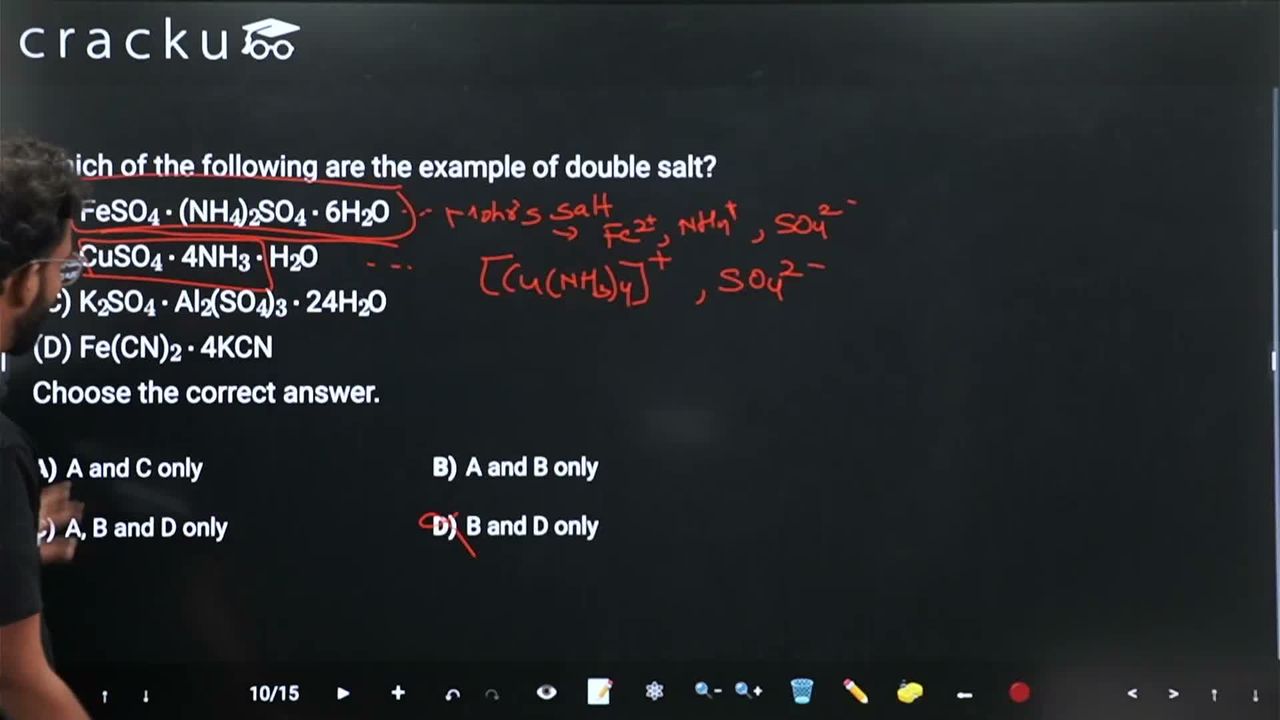
Which of the following are the example of double salt?
(A) FeSO$$_4$$ $$\cdot$$ (NH$$_4$$)$$_2$$SO$$_4$$ $$\cdot$$ 6H$$_2$$O
(B) CuSO$$_4$$ $$\cdot$$ 4NH$$_3$$ $$\cdot$$ H$$_2$$O
(C) K$$_2$$SO$$_4$$ $$\cdot$$ Al$$_2$$(SO$$_4$$)$$_3$$ $$\cdot$$ 24H$$_2$$O
(D) Fe(CN)$$_2$$ $$\cdot$$ 4KCN
Choose the correct answer.
A double salt is a salt that contains two different cations or anions. It dissociates completely into its constituent ions in aqueous solution and does not retain the identity of its complex ion.
In contrast, a coordination compound retains its complex ion identity in solution.
Let us analyze each compound:
(A) $$FeSO_4 \cdot (NH_4)_2SO_4 \cdot 6H_2O$$ - This is Mohr's salt, a classic example of a double salt. In solution, it gives $$Fe^{2+}$$, $$NH_4^+$$, and $$SO_4^{2-}$$ ions separately. Double salt.
(B) $$CuSO_4 \cdot 4NH_3 \cdot H_2O$$ - This is $$[Cu(NH_3)_4]SO_4 \cdot H_2O$$, a coordination compound. The $$[Cu(NH_3)_4]^{2+}$$ ion retains its identity in solution.
(C) $$K_2SO_4 \cdot Al_2(SO_4)_3 \cdot 24H_2O$$ - This is potash alum, a double salt. It dissociates completely into $$K^+$$, $$Al^{3+}$$, and $$SO_4^{2-}$$ ions in solution. Double salt.
(D) $$Fe(CN)_2 \cdot 4KCN$$ - This is $$K_4[Fe(CN)_6]$$, potassium ferrocyanide, a coordination compound. The $$[Fe(CN)_6]^{4-}$$ ion retains its identity in solution.
Therefore, the double salts are A and C only.
Was this solution helpful?
Click on the Email ☝️ to Watch the Video Solution
Create a FREE account and get:
_1.webp)

Educational materials for JEE preparation

Ask our AI anything

AI can make mistakes. Please verify important information.
AI can make mistakes. Please verify important information.
