
Join Our JEE Preparation Group
Prep with like-minded aspirants; Get access to free daily tests and study material.
Sign in
Please select an account to continue using cracku.in
↓ →
Join Our JEE Preparation Group
Prep with like-minded aspirants; Get access to free daily tests and study material.
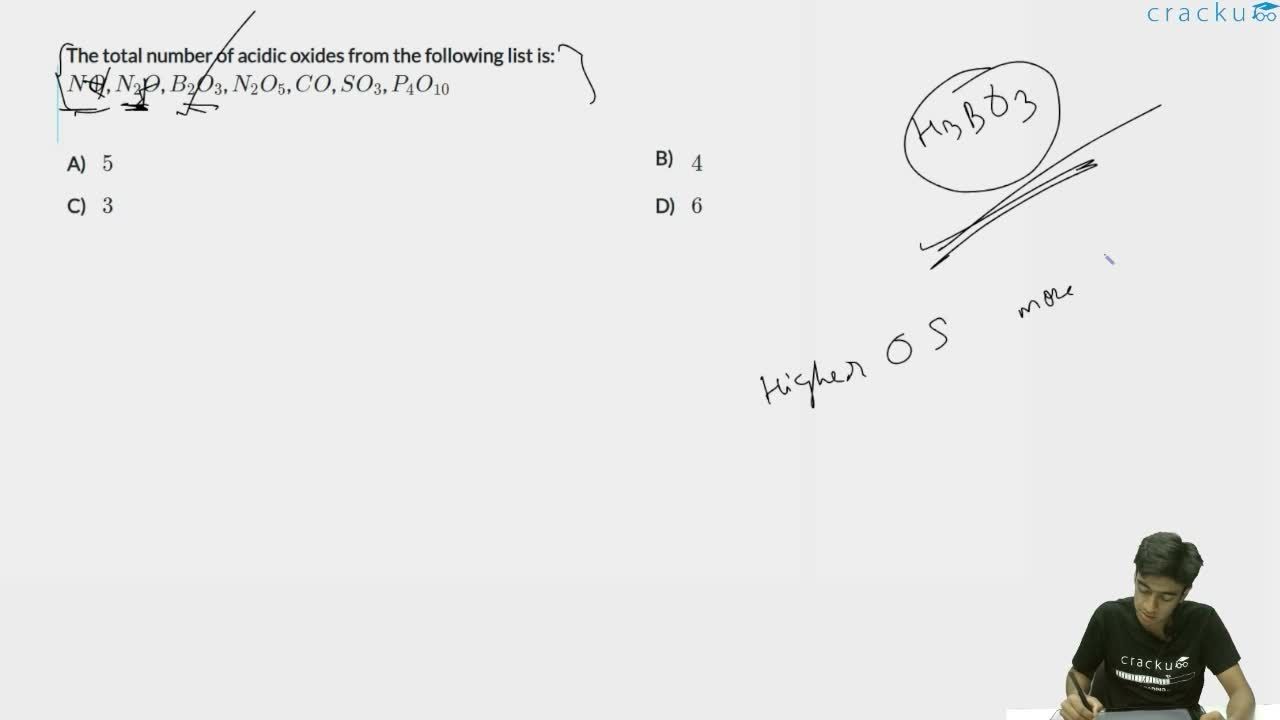
The total number of acidic oxides from the following list is:
$$NO$$, $$N_2O$$, $$B_2O_3$$, $$N_2O_5$$, $$CO$$, $$SO_3$$, $$P_4O_{10}$$
We need to count the number of acidic oxides from the given list: $$NO$$, $$N_2O$$, $$B_2O_3$$, $$N_2O_5$$, $$CO$$, $$SO_3$$, $$P_4O_{10}$$.
To begin with, $$NO$$ (Nitric oxide) behaves as a neutral oxide since it does not react with water to form an acid or a base.
Likewise, $$N_2O$$ (Nitrous oxide) is also a neutral oxide and remains unreactive with water in terms of acid or base formation.
On the other hand, $$B_2O_3$$ (Boron trioxide) is an acidic oxide and reacts with water to produce boric acid according to $$B_2O_3 + 3H_2O \rightarrow 2H_3BO_3$$.
Similarly, $$N_2O_5$$ (Dinitrogen pentoxide) is acidic and yields nitric acid when combined with water: $$N_2O_5 + H_2O \rightarrow 2HNO_3$$.
In contrast, $$CO$$ (Carbon monoxide) is a neutral oxide and does not form an acid upon reaction with water.
Meanwhile, $$SO_3$$ (Sulphur trioxide) is an acidic oxide that produces sulphuric acid in water: $$SO_3 + H_2O \rightarrow H_2SO_4$$.
Finally, $$P_4O_{10}$$ (Phosphorus pentoxide) also exhibits acidic behavior by forming phosphoric acid: $$P_4O_{10} + 6H_2O \rightarrow 4H_3PO_4$$.
From these classifications, the acidic oxides are $$B_2O_3$$, $$N_2O_5$$, $$SO_3$$, and $$P_4O_{10}$$, which gives a total of 4 acidic oxides.
Therefore, the correct answer is Option B.
Was this solution helpful?
Click on the Email ☝️ to Watch the Video Solution
Create a FREE account and get:
_1.webp)

Educational materials for JEE preparation

Ask our AI anything

AI can make mistakes. Please verify important information.
AI can make mistakes. Please verify important information.
