
Join Our JEE Preparation Group
Prep with like-minded aspirants; Get access to free daily tests and study material.
Sign in
Please select an account to continue using cracku.in
↓ →
Join Our JEE Preparation Group
Prep with like-minded aspirants; Get access to free daily tests and study material.
We need to determine the magnetic properties of $$[Ni(CO)_4]$$ and $$[NiCl_4]^{2-}$$.
Key Concepts:
(i) The magnetic behaviour of a coordination compound depends on the number of unpaired electrons, which is determined by the metal's oxidation state, its d-electron configuration, and the crystal field splitting caused by the ligands.
(ii) Strong field ligands (like CO) cause large splitting and tend to pair electrons; weak field ligands (like Cl$$^-$$) cause small splitting.
Analysis of [Ni(CO)$$_4$$]:
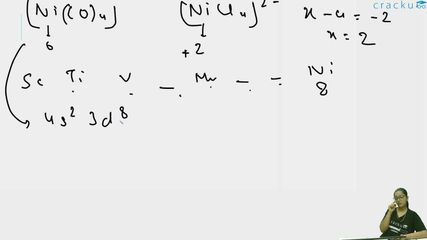
Step 1: Find the oxidation state of Ni. CO is a neutral ligand, so the complex is neutral. Therefore, Ni is in the 0 oxidation state: Ni(0).
Step 2: Ni(0) has the electron configuration [Ar]3d$$^{8}$$4s$$^2$$, giving 10 valence electrons, which redistribute to 3d$$^{10}$$ in the complex.
Step 3: With a d$$^{10}$$ configuration (all d orbitals are completely filled), there are 0 unpaired electrons. The complex is diamagnetic.
Step 4: The geometry is tetrahedral (sp$$^3$$ hybridization), consistent with 4 ligands around Ni(0).
Analysis of [NiCl$$_4$$]$$^{2-}$$:
Step 1: Find the oxidation state. Cl$$^-$$ has charge -1, and the complex has overall charge -2: Ni + 4(-1) = -2, so Ni = +2. Ni$$^{2+}$$ has the configuration [Ar]3d$$^8$$.
Step 2: Cl$$^-$$ is a weak field ligand (low in the spectrochemical series). With 4 ligands and a weak field, the geometry is tetrahedral.
Step 3: In a tetrahedral crystal field with d$$^8$$, the splitting $$\Delta_t$$ is small. The electrons fill as: $$e^4 \, t_2^4$$. Using Hund's rule for the weak field, there are 2 unpaired electrons. The complex is paramagnetic.
The correct answer is Option (4): [Ni(CO)$$_4$$] is diamagnetic, [NiCl$$_4$$]$$^{2-}$$ is paramagnetic.
Was this solution helpful?
Click on the Email ☝️ to Watch the Video Solution
Create a FREE account and get:
_1.webp)

Educational materials for JEE preparation

Ask our AI anything

AI can make mistakes. Please verify important information.
AI can make mistakes. Please verify important information.
