
Join Our JEE Preparation Group
Prep with like-minded aspirants; Get access to free daily tests and study material.
Sign in
Please select an account to continue using cracku.in
↓ →
Join Our JEE Preparation Group
Prep with like-minded aspirants; Get access to free daily tests and study material.
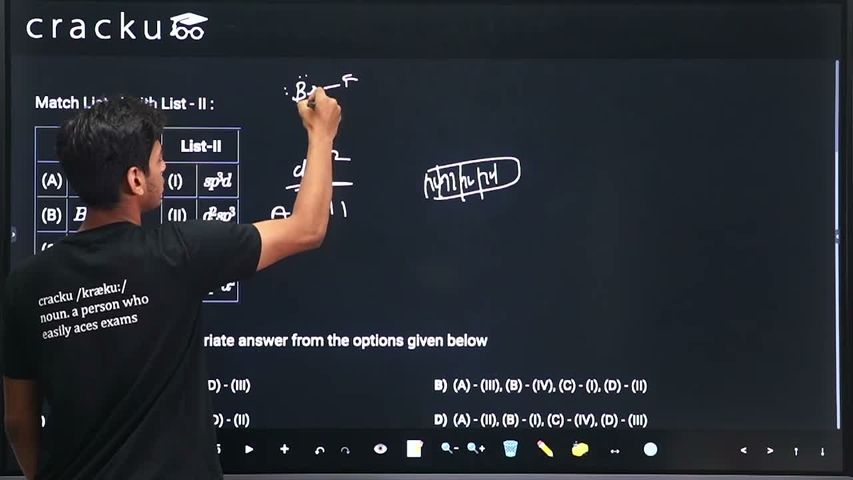
Match List - I with List - II :
| List-I | List-II | ||
|---|---|---|---|
| (A) | $$[PtCl_4]^{2-}$$ | (I) | $$sp^3d$$ |
| (B) | $$BrF_5$$ | (II) | $$d^2sp^3$$ |
| (C) | $$PCl_5$$ | (III) | $$dsp^2$$ |
| (D) | $$[Co(NH_3)_6]^{3+}$$ | (IV) | $$sp^3d^2$$ |
Choose the most appropriate answer from the options given below
We need to match each species with its correct hybridization.
(A) $$[PtCl_4]^{2-}$$:
Pt is in +2 oxidation state ($$Pt^{2+}$$) with electronic configuration $$[Xe]5d^8$$.
$$Pt^{2+}$$ is a $$d^8$$ system. With 4 $$Cl^-$$ ligands (weak field for most metals, but Pt²⁺ being a 5d metal with large crystal field splitting always forms square planar complexes).
Square planar geometry corresponds to $$dsp^2$$ hybridization → matches (III).
(B) $$BrF_5$$:
Br has 7 valence electrons. With 5 bond pairs and 1 lone pair (total 6 electron pairs around Br).
6 electron pairs require $$sp^3d^2$$ hybridization → square pyramidal geometry → matches (IV).
(C) $$PCl_5$$:
P has 5 valence electrons. With 5 bond pairs and 0 lone pairs (total 5 electron pairs around P).
5 electron pairs require $$sp^3d$$ hybridization → trigonal bipyramidal geometry → matches (I).
(D) $$[Co(NH_3)_6]^{3+}$$:
Co is in +3 oxidation state ($$Co^{3+}$$) with electronic configuration $$[Ar]3d^6$$.
$$NH_3$$ is a strong field ligand, so all 6 electrons in $$3d$$ pair up, leaving two empty $$3d$$ orbitals available.
The hybridization is $$d^2sp^3$$ (inner orbital complex) → octahedral geometry → matches (II).
Final matching:
(A) - (III), (B) - (IV), (C) - (I), (D) - (II)
The correct answer is Option B.
Was this solution helpful?
Click on the Email ☝️ to Watch the Video Solution
Create a FREE account and get:
_1.webp)

Educational materials for JEE preparation

Ask our AI anything

AI can make mistakes. Please verify important information.
AI can make mistakes. Please verify important information.
