
Join Our JEE Preparation Group
Prep with like-minded aspirants; Get access to free daily tests and study material.
Sign in
Please select an account to continue using cracku.in
↓ →
Join Our JEE Preparation Group
Prep with like-minded aspirants; Get access to free daily tests and study material.
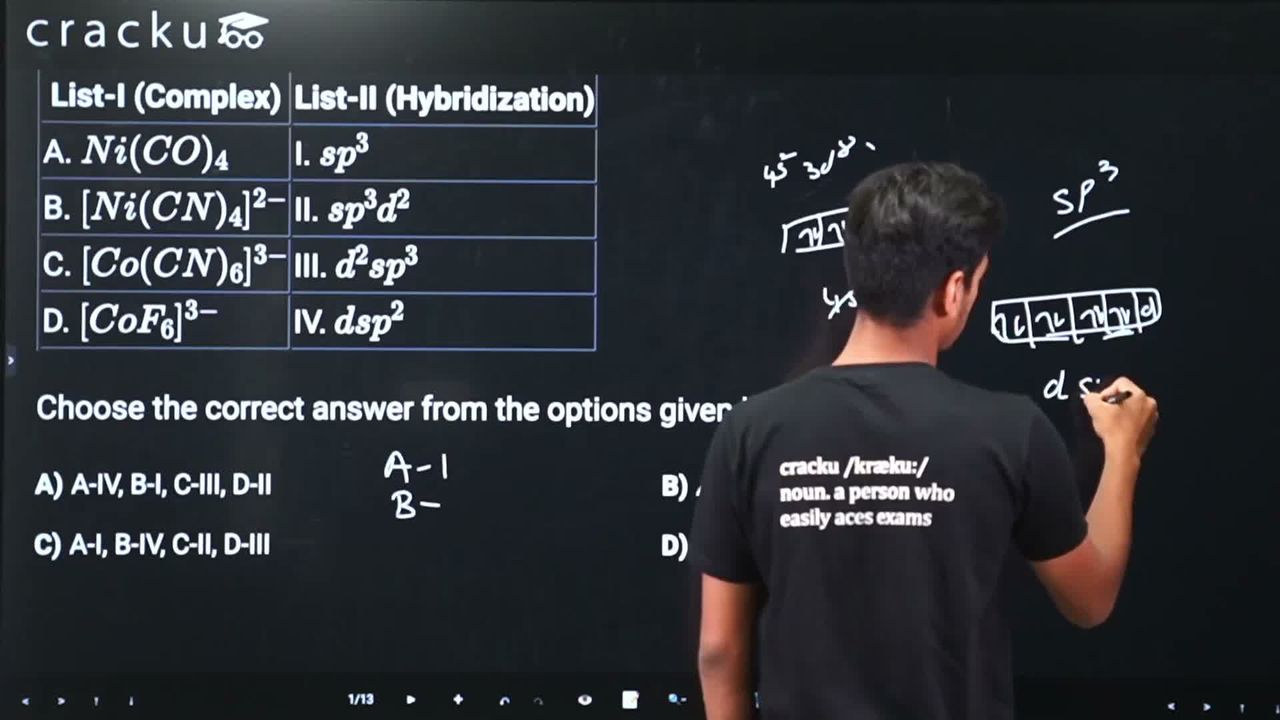
Match List-I with List-II
| List-I (Complex) | List-II (Hybridization) |
|---|---|
| A. $$Ni(CO)_4$$ | I. $$sp^3$$ |
| B. $$[Ni(CN)_4]^{2-}$$ | II. $$sp^3d^2$$ |
| C. $$[Co(CN)_6]^{3-}$$ | III. $$d^2sp^3$$ |
| D. $$[CoF_6]^{3-}$$ | IV. $$dsp^2$$ |
Choose the correct answer from the options given below
We need to match each complex with its hybridization by analyzing the electronic configuration and geometry of the central metal ion in each complex.
A. $$Ni(CO)_4$$: Nickel in $$Ni(CO)_4$$ is in the 0 oxidation state (since CO is a neutral ligand). The electronic configuration of Ni (Z = 28) is $$[Ar] 3d^8 4s^2$$. In $$Ni(CO)_4$$, CO is a strong field ligand, so all electrons pair up in the 3d orbitals, giving a $$3d^{10}$$ configuration with all d-orbitals filled. Since no d-orbitals are available, the metal uses one 4s and three 4p orbitals for bonding, resulting in $$sp^3$$ hybridization with a tetrahedral geometry. So A matches with I ($$sp^3$$).
B. $$[Ni(CN)_4]^{2-}$$: Nickel is in the +2 oxidation state, giving a $$3d^8$$ configuration. CN$$^-$$ is a strong field ligand, which forces the electrons to pair up. The 8 d-electrons pair into four of the five 3d orbitals, leaving one 3d orbital empty. This empty $$3d$$ orbital, along with one $$4s$$ and two $$4p$$ orbitals, undergoes $$dsp^2$$ hybridization, forming a square planar geometry. So B matches with IV ($$dsp^2$$).
C. $$[Co(CN)_6]^{3-}$$: Cobalt is in the +3 oxidation state, giving a $$3d^6$$ configuration. CN$$^-$$ is a strong field ligand, so all six d-electrons pair into three orbitals, leaving two 3d orbitals empty. These two empty 3d orbitals combine with one 4s and three 4p orbitals to give $$d^2sp^3$$ hybridization (inner orbital complex) with an octahedral geometry. So C matches with III ($$d^2sp^3$$).
D. $$[CoF_6]^{3-}$$: Cobalt is again in the +3 oxidation state with a $$3d^6$$ configuration. However, $$F^-$$ is a weak field ligand, so no pairing of electrons occurs beyond what is already present. The 3d orbitals are not available for bonding (they are occupied). The metal uses the outer orbitals — two 4d, one 4s, and three 4p orbitals — giving $$sp^3d^2$$ hybridization (outer orbital complex) with an octahedral geometry. So D matches with II ($$sp^3d^2$$).
The correct matching is: A-I, B-IV, C-III, D-II.
Hence, the correct answer is Option B.
Was this solution helpful?
Click on the Email ☝️ to Watch the Video Solution
Create a FREE account and get:
_1.webp)

Educational materials for JEE preparation

Ask our AI anything

AI can make mistakes. Please verify important information.
AI can make mistakes. Please verify important information.
