Join Our JEE Preparation Group
Prep with like-minded aspirants; Get access to free daily tests and study material.
Sign in
Please select an account to continue using cracku.in
↓ →
Join Our JEE Preparation Group
Prep with like-minded aspirants; Get access to free daily tests and study material.
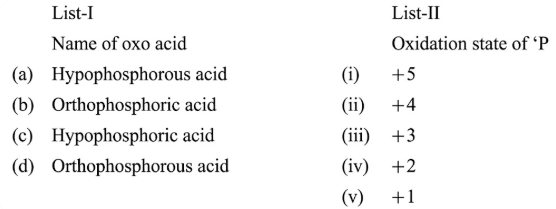
We need to determine the oxidation state of phosphorus in each oxo acid.
(a) Hypophosphorous acid ($$H_3PO_2$$): The formula has 3 hydrogen atoms, 1 phosphorus atom, and 2 oxygen atoms. However, only 1 hydrogen is ionisable (acidic), and the other 2 are bonded directly to P. Using the oxidation state calculation: let the oxidation state of P be $$x$$. Since there is 1 acidic H (as $$H^+$$) and 2 P-H bonds, we have $$x + 2(+1) + 1(+1) + 2(-2) = 0$$, giving $$x + 3 - 4 = 0$$, so $$x = +1$$. This matches (v).
(b) Orthophosphoric acid ($$H_3PO_4$$): All three hydrogens are acidic. The oxidation state of P: $$3(+1) + x + 4(-2) = 0$$, giving $$3 + x - 8 = 0$$, so $$x = +5$$. This matches (i).
(c) Hypophosphoric acid ($$H_4P_2O_6$$): This contains two P atoms. The oxidation state: $$4(+1) + 2x + 6(-2) = 0$$, giving $$4 + 2x - 12 = 0$$, so $$2x = 8$$ and $$x = +4$$. This matches (ii).
(d) Orthophosphorous acid ($$H_3PO_3$$): This has 2 ionisable hydrogens and 1 P-H bond. The oxidation state: $$2(+1) + 1(+1) + x + 3(-2) = 0$$, giving $$3 + x - 6 = 0$$, so $$x = +3$$. This matches (iii).
The correct matching is (a)-(v), (b)-(i), (c)-(ii), (d)-(iii), which corresponds to Option (1).
Was this solution helpful?
Create a FREE account and get:
_1.webp)

Educational materials for JEE preparation

Ask our AI anything

AI can make mistakes. Please verify important information.
AI can make mistakes. Please verify important information.