
Join Our JEE Preparation Group
Prep with like-minded aspirants; Get access to free daily tests and study material.
Sign in
Please select an account to continue using cracku.in
↓ →
Join Our JEE Preparation Group
Prep with like-minded aspirants; Get access to free daily tests and study material.
Consider the following reaction,
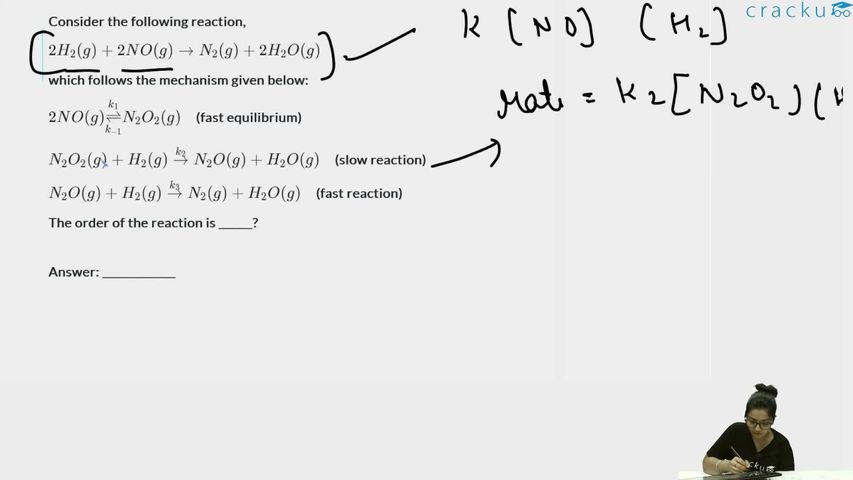
$$2H_2(g) + 2NO(g) \rightarrow N_2(g) + 2H_2O(g)$$
which follows the mechanism given below:
$$2NO(g) \underset{k_{-1}}{\overset{k_1}{\rightleftharpoons}} N_2O_2(g)$$ (fast equilibrium)
$$N_2O_2(g) + H_2(g) \overset{k_2}{\rightarrow} N_2O(g) + H_2O(g)$$ (slow reaction)
$$N_2O(g) + H_2(g) \overset{k_3}{\rightarrow} N_2(g) + H_2O(g)$$ (fast reaction)
The order of the reaction is ______?
Correct Answer: 3
We need to determine the overall rate law and the total order of the reaction for the given chemical equation based on its multi-step reaction mechanism.
Step 1: Fast Equilibrium
$$2\text{NO}_{(g)} \underset{k_{-1}}{\overset{k_1}{\rightleftharpoons}} \text{N}_2\text{O}_{2(g)} \quad (\text{Fast equilibrium})$$Since this step reaches a rapid equilibrium, we can express its equilibrium constant ($$K_{eq}$$) in terms of the rate constants of the forward ($$k_1$$) and reverse ($$k_{-1}$$) reactions:
$$K_{eq} = \frac{k_1}{k_{-1}} = \frac{[\text{N}_2\text{O}_2]}{[\text{NO}]^2}$$Rearranging this equation gives the concentration of the intermediate $$\text{N}_2\text{O}_2$$:
$$[\text{N}_2\text{O}_2] = \frac{k_1}{k_{-1}} [\text{NO}]^2$$Step 2: Rate-Determining Step (RDS)
$$\text{N}_2\text{O}_{2(g)} + \text{H}_{2(g)} \overset{k_2}{\rightarrow} \text{N}_2\text{O}_{(g)} + \text{H}_2\text{O}_{(g)} \quad (\text{Slow reaction})$$The slowest step in a reaction mechanism determines the overall rate of the chemical reaction. Therefore, the rate law expression is derived directly from this step:
$$\text{Rate} = k_2 [\text{N}_2\text{O}_2] [\text{H}_2]$$A final rate law must only contain the concentrations of the starting reactants, not unstable intermediates like $$\text{N}_2\text{O}_2$$. Substituting our expression for $$[\text{N}_2\text{O}_2]$$ into the rate law gives:
$$\text{Rate} = k_2 \left( \frac{k_1}{k_{-1}} [\text{NO}]^2 \right) [\text{H}_2]$$
Combining all individual constants into a single effective rate constant ($$k = \frac{k_1 k_2}{k_{-1}}$$) yields the final overall rate law:
$$\text{Rate} = k [\text{NO}]^2 [\text{H}_2]^1$$
$$\text{Overall Order of Reaction} = 2 + 1 = 3$$
By applying the steady-state equilibrium approximation to the fast step, the overall reaction mechanism follows third-order kinetics.
Answer: 3
Was this solution helpful?
Click on the Email ☝️ to Watch the Video Solution
Create a FREE account and get:
_1.webp)

Educational materials for JEE preparation

Ask our AI anything

AI can make mistakes. Please verify important information.
AI can make mistakes. Please verify important information.
