
Join Our JEE Preparation Group
Prep with like-minded aspirants; Get access to free daily tests and study material.
Sign in
Please select an account to continue using cracku.in
↓ →
Join Our JEE Preparation Group
Prep with like-minded aspirants; Get access to free daily tests and study material.
The number of non-ionisable hydrogen atoms present in the final product obtained from the hydrolysis of PCl$$_5$$ is:
We need to find the number of non-ionisable hydrogen atoms in the final product obtained from the hydrolysis of $$PCl_5$$.
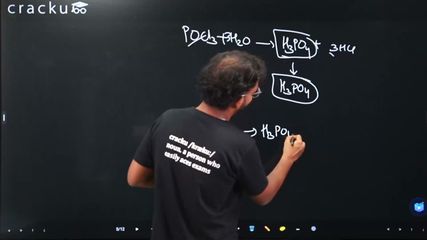
The hydrolysis of $$PCl_5$$ proceeds in steps. First, partial hydrolysis gives phosphoryl chloride:
$$PCl_5 + H_2O \rightarrow POCl_3 + 2HCl$$
Then, $$POCl_3$$ undergoes further hydrolysis with excess water:
$$POCl_3 + 3H_2O \rightarrow H_3PO_4 + 3HCl$$
The overall reaction for complete hydrolysis is:
$$PCl_5 + 4H_2O \rightarrow H_3PO_4 + 5HCl$$
The final product is orthophosphoric acid ($$H_3PO_4$$).
The structure of $$H_3PO_4$$ has a central phosphorus atom bonded to one $$P=O$$ double bond and three $$P-OH$$ groups. All three hydrogen atoms are attached to oxygen atoms through $$O-H$$ bonds.
Since all three $$O-H$$ bonds are ionisable (each can release an $$H^+$$ ion), $$H_3PO_4$$ is a triprotic acid:
$$H_3PO_4 \rightarrow H^+ + H_2PO_4^-$$
$$H_2PO_4^- \rightarrow H^+ + HPO_4^{2-}$$
$$HPO_4^{2-} \rightarrow H^+ + PO_4^{3-}$$
There are no non-ionisable hydrogen atoms in $$H_3PO_4$$. All three hydrogen atoms are ionisable because they are all bonded to highly electronegative oxygen atoms via $$O-H$$ bonds.
Note: In contrast, phosphorous acid ($$H_3PO_3$$) has one $$P-H$$ bond which is non-ionisable, but $$H_3PO_4$$ has no such $$P-H$$ bond.
The number of non-ionisable hydrogen atoms = 0.
The correct answer is Option A.
Was this solution helpful?
Click on the Email ☝️ to Watch the Video Solution
Create a FREE account and get:
_1.webp)

Educational materials for JEE preparation

Ask our AI anything

AI can make mistakes. Please verify important information.
AI can make mistakes. Please verify important information.
