
Join Our JEE Preparation Group
Prep with like-minded aspirants; Get access to free daily tests and study material.
Sign in
Please select an account to continue using cracku.in
↓ →
Join Our JEE Preparation Group
Prep with like-minded aspirants; Get access to free daily tests and study material.
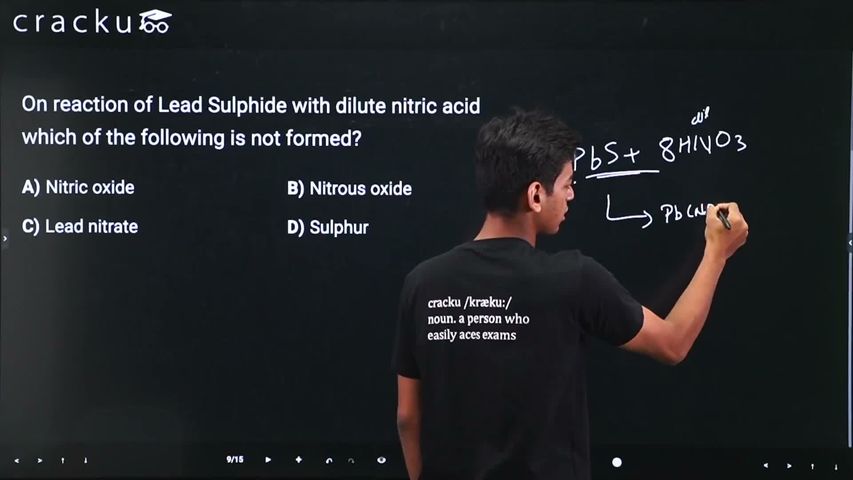
On reaction of Lead Sulphide with dilute nitric acid which of the following is not formed?
We need to identify which product is NOT formed when lead sulphide (PbS) reacts with dilute nitric acid ($$HNO_3$$).
First, the balanced chemical equation for this reaction is:
$$ 3PbS + 8HNO_3(\text{dilute}) \rightarrow 3Pb(NO_3)_2 + 3S + 2NO\uparrow + 4H_2O $$
Next, we examine why these products form.
In this reaction:
- $$PbS$$ is oxidized: $$S^{2-}$$ in PbS is oxidized to elemental sulphur $$S^0$$ (oxidation state changes from $$-2$$ to $$0$$).
- $$HNO_3$$ acts as the oxidizing agent: $$N^{+5}$$ in $$HNO_3$$ is reduced to $$N^{+2}$$ in $$NO$$ (nitric oxide).
- $$Pb^{2+}$$ combines with $$NO_3^-$$ to form lead nitrate $$Pb(NO_3)_2$$.
Now, we identify which products are formed and which are not.
The products of this reaction are:
- Lead nitrate ($$Pb(NO_3)_2$$) — formed
- Sulphur ($$S$$) — formed
- Nitric oxide ($$NO$$) — formed
- Water ($$H_2O$$) — formed
Nitrous oxide ($$N_2O$$) is NOT a product of this reaction. Nitrous oxide would require nitrogen to be reduced to the $$+1$$ oxidation state, but with dilute $$HNO_3$$ and PbS, the reduction product is nitric oxide ($$NO$$, where nitrogen is in the $$+2$$ state).
The correct answer is Option (2): Nitrous oxide.
Was this solution helpful?
Click on the Email ☝️ to Watch the Video Solution
Create a FREE account and get:
_1.webp)

Educational materials for JEE preparation

Ask our AI anything

AI can make mistakes. Please verify important information.
AI can make mistakes. Please verify important information.
