
Join Our JEE Preparation Group
Prep with like-minded aspirants; Get access to free daily tests and study material.
Sign in
Please select an account to continue using cracku.in
↓ →
Join Our JEE Preparation Group
Prep with like-minded aspirants; Get access to free daily tests and study material.
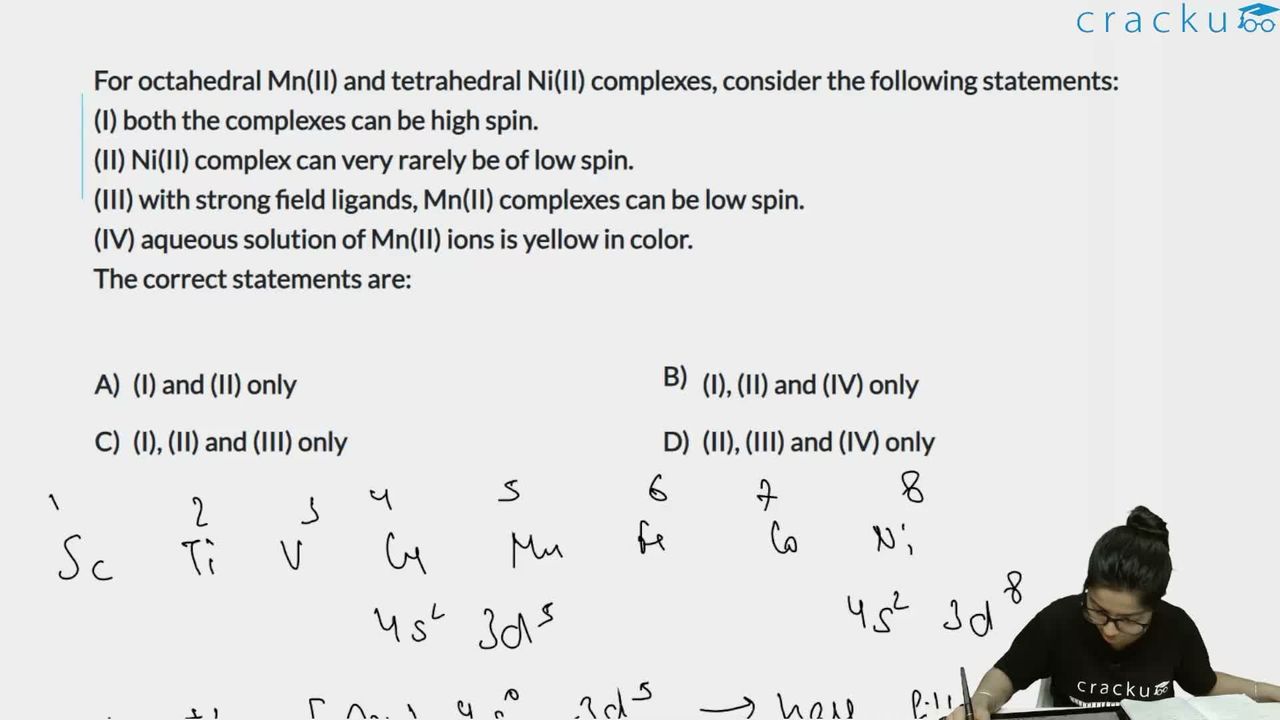
For octahedral Mn(II) and tetrahedral Ni(II) complexes, consider the following statements:
(I) both the complexes can be high spin.
(II) Ni(II) complex can very rarely be of low spin.
(III) with strong field ligands, Mn(II) complexes can be low spin.
(IV) aqueous solution of Mn(II) ions is yellow in color.
The correct statements are:
First, we identify the electronic configurations of the metal ions in their ground state (gas phase): Mn has atomic number 25 and Ni has 28. Removing two s-electrons for the +2 state gives
$$\text{Mn}^{2+}: [\text{Ar}]\,3d^5,$$
$$\text{Ni}^{2+}: [\text{Ar}]\,3d^8.$$
We now examine the two geometries mentioned.
For an octahedral field the crystal-field splitting is denoted by $$\Delta_o$$, while for a tetrahedral field the splitting is smaller, $$\Delta_t=\dfrac{4}{9}\,\Delta_o.$$ High-spin or low-spin behaviour is governed by a comparison of this splitting with the intra-electronic pairing energy $$P.$$ The rule is:
If $$\Delta \lt P$$, electrons occupy the higher set of orbitals before pairing → high spin.
If $$\Delta \gt P$$, electrons pair in the lower set first → low spin.
Statement (I): “Both the complexes can be high spin.”
• Octahedral $$\text{Mn}^{2+}$$ is a $$d^5$$ system. Because $$\Delta_o$$ for an ion in the +2 state is moderate, $$\Delta_o\lt P$$ in almost every ligand environment, so the configuration is generally high-spin $$t_{2g}^3e_g^2$$ (five unpaired electrons).
• Tetrahedral $$\text{Ni}^{2+}$$ is a $$d^8$$ system. With $$\Delta_t$$ being only $$\dfrac49\Delta_o,$$ we certainly have $$\Delta_t\lt P,$$ giving the high-spin configuration $$e^4t_2^4$$ (two unpaired electrons).
Since each complex indeed can exist in a high-spin form, statement (I) is true.
Statement (II): “Ni(II) complex can very rarely be of low spin.”
A tetrahedral field has a small splitting; to obtain low spin we would require an extraordinarily large $$\Delta_t$$ (i.e., an exceptionally strong field ligand set). Achieving $$\Delta_t\gt P$$ under tetrahedral geometry is practically impossible, though a handful of isolated cases are known in the literature. Thus low-spin tetrahedral $$\text{Ni}^{2+}$$ is very rare, exactly as the statement says. Hence statement (II) is true.
Statement (III): “With strong field ligands, Mn(II) complexes can be low spin.”
For $$\text{Mn}^{2+}(d^5)$$ in an octahedral field, low spin would mean the electrons all go into the lower set, $$t_{2g}^5e_g^0,$$ giving one unpaired electron. To force this, we need $$\Delta_o\gt P.$$ Although unusual (because +2 oxidation state gives a relatively small splitting), it is possible with sufficiently strong field ligands such as CN−, CO, or phosphines containing π-acceptor character. Therefore the statement that low spin is attainable with strong field ligands is correct.
Statement (IV): “Aqueous solution of Mn(II) ions is yellow in colour.”
The aquated ion is $$[\text{Mn(OH}_2)_6]^{2+}.$$ Because its d-d transitions are spin-forbidden (high-spin $$d^5$$), the complex is only very weakly coloured, appearing pale pink to colourless, not yellow. Statement (IV) is false.
We have now assessed each statement:
(I) True (II) True (III) True (IV) False
So the correct set of statements is (I), (II) and (III) only.
Hence, the correct answer is Option C.
Was this solution helpful?
Click on the Email ☝️ to Watch the Video Solution
Create a FREE account and get:
_1.webp)

Educational materials for JEE preparation

Ask our AI anything

AI can make mistakes. Please verify important information.
AI can make mistakes. Please verify important information.
