
Join Our JEE Preparation Group
Prep with like-minded aspirants; Get access to free daily tests and study material.
Sign in
Please select an account to continue using cracku.in
↓ →
Join Our JEE Preparation Group
Prep with like-minded aspirants; Get access to free daily tests and study material.
Consider that $$d^6$$ metal ion $$(M^{2+})$$ forms a complex with aqua ligands, and the spin only magnetic moment of the complex is 4.90 BM. The geometry and the crystal field stabilization energy of the complex is:
The spin-only magnetic moment of a transition-metal complex is related to the number of unpaired electrons by the formula
$$\mu_{\text{so}}=\sqrt{\,n(n+2)\,}\;\text{BM},$$
where $$n$$ is the number of unpaired electrons. The observed value is $$\mu_{\text{so}}=4.90\ \text{BM}.$$ We therefore write
$$4.90^2=n(n+2)\;\Longrightarrow\;24.01\approx n(n+2).$$
Choosing integral $$n$$, the product $$4(4+2)=24$$ reproduces the value almost exactly, so
$$n=4.$$
Hence the $$d^6$$ ion possesses four unpaired electrons in the complex.
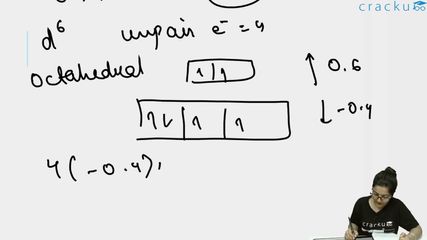
With aqua ligands $$(\text{H}_2\text{O})$$, the ligand field is weak and the complex will be high-spin, so we must distribute six $$d$$ electrons so that four remain unpaired.
Octahedral possibility. In an octahedral field the splitting is $$t_{2g}-e_g$$, the high-spin configuration for $$d^6$$ being
$$t_{2g}^4e_g^2,$$
which indeed has four unpaired electrons. The crystal-field stabilisation energy (CFSE) is obtained from the standard octahedral weights $$(-0.4\Delta_0)$$ for each $$t_{2g}$$ electron and $$+0.6\Delta_0$$ for each $$e_g$$ electron:
$$\text{CFSE}=4(-0.4\Delta_0)+2(+0.6\Delta_0)=-1.6\Delta_0+1.2\Delta_0=-0.4\Delta_0.$$
No listed option contains $$-0.4\Delta_0$$, so the octahedral alternative is ruled out by the given choices.
Tetrahedral possibility. In a tetrahedral field the splitting set is reversed and reduced in magnitude, the lower set being the twofold $$e$$ orbitals at $$-0.6\Delta_t$$ each and the upper set the threefold $$t_2$$ orbitals at $$+0.4\Delta_t$$ each. Filling electrons according to Hund’s rule for a weak field (high-spin) gives
$$e^3t_2^3,$$
that is, three electrons in the lower $$e$$ set (one orbital now paired) and three singly occupied $$t_2$$ orbitals. This arrangement leaves four electrons unpaired, exactly as required by the magnetic data.
The CFSE is obtained by adding the individual contributions:
$$\text{CFSE}=3(-0.6\Delta_t)+3(+0.4\Delta_t)=-1.8\Delta_t+1.2\Delta_t=-0.6\Delta_t.$$
Because the number of electron pairs in this configuration (one pair) is the same as in the free ion, no additional pairing energy term $$P$$ appears. The final stabilisation energy is therefore simply $$-0.6\Delta_t$$.
The geometry compatible with both the magnetic moment and the listed energy expression is thus tetrahedral, with crystal-field stabilisation energy $$-0.6\Delta_t$$.
Hence, the correct answer is Option B.
Was this solution helpful?
Click on the Email ☝️ to Watch the Video Solution
Create a FREE account and get:
_1.webp)

Educational materials for JEE preparation

Ask our AI anything

AI can make mistakes. Please verify important information.
AI can make mistakes. Please verify important information.
