
Join Our JEE Preparation Group
Prep with like-minded aspirants; Get access to free daily tests and study material.
Sign in
Please select an account to continue using cracku.in
↓ →
Join Our JEE Preparation Group
Prep with like-minded aspirants; Get access to free daily tests and study material.
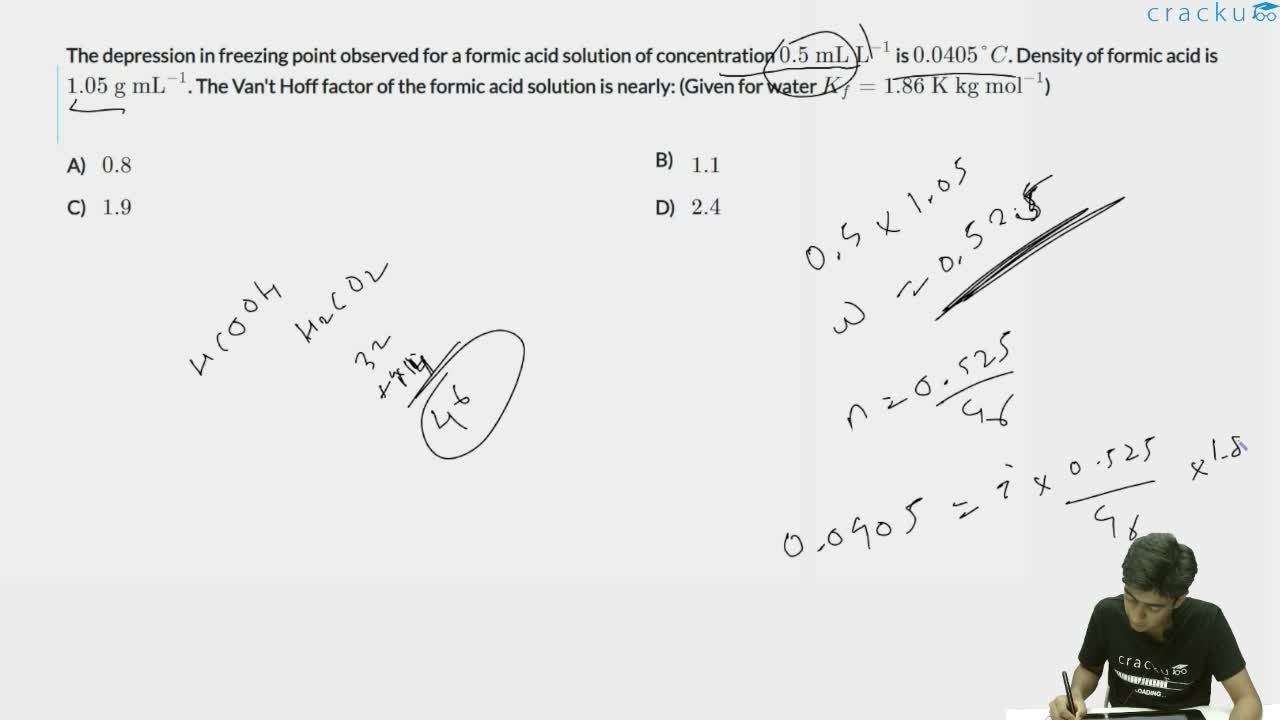
The depression in freezing point observed for a formic acid solution of concentration $$0.5 \text{ mL L}^{-1}$$ is $$0.0405°C$$. Density of formic acid is $$1.05 \text{ g mL}^{-1}$$. The Van't Hoff factor of the formic acid solution is nearly: (Given for water $$K_f = 1.86 \text{ K kg mol}^{-1}$$)
We need to find the Van't Hoff factor (i) for formic acid solution.
Concentration = $$0.5 \text{ mL L}^{-1}$$ means 0.5 mL of formic acid in 1 L of solution (approximately 1 L of water for a dilute solution), so the mass of formic acid is Volume $$\times$$ Density = $$0.5 \times 1.05 = 0.525 \text{ g}$$.
The molar mass of formic acid ($$HCOOH$$) is $$1 + 12 + 16 + 16 + 1 = 46 \text{ g mol}^{-1}$$, and the moles of formic acid present are $$\dfrac{0.525}{46} = 0.01141 \text{ mol}$$. Since the solution is very dilute, the mass of the solvent (water) is approximately 1000 g = 1 kg, giving a molality of $$\dfrac{0.01141}{1} = 0.01141 \text{ mol kg}^{-1}$$.
Applying the depression in freezing point formula $$\Delta T_f = i \cdot K_f \cdot m$$, we have $$0.0405 = i \times 1.86 \times 0.01141$$ which simplifies to $$0.0405 = i \times 0.02122$$, and hence $$i = \dfrac{0.0405}{0.02122} = 1.908 \approx 1.9$$.
The Van't Hoff factor $$i \approx 1.9$$ indicates that formic acid nearly completely dissociates in water as: $$HCOOH \rightleftharpoons HCOO^- + H^+$$, giving approximately 2 particles per molecule.
Hence, the correct answer is Option C.
Was this solution helpful?
Click on the Email ☝️ to Watch the Video Solution
Create a FREE account and get:
_1.webp)

Educational materials for JEE preparation

Ask our AI anything

AI can make mistakes. Please verify important information.
AI can make mistakes. Please verify important information.
