
Join Our JEE Preparation Group
Prep with like-minded aspirants; Get access to free daily tests and study material.
Sign in
Please select an account to continue using cracku.in
↓ →
Join Our JEE Preparation Group
Prep with like-minded aspirants; Get access to free daily tests and study material.
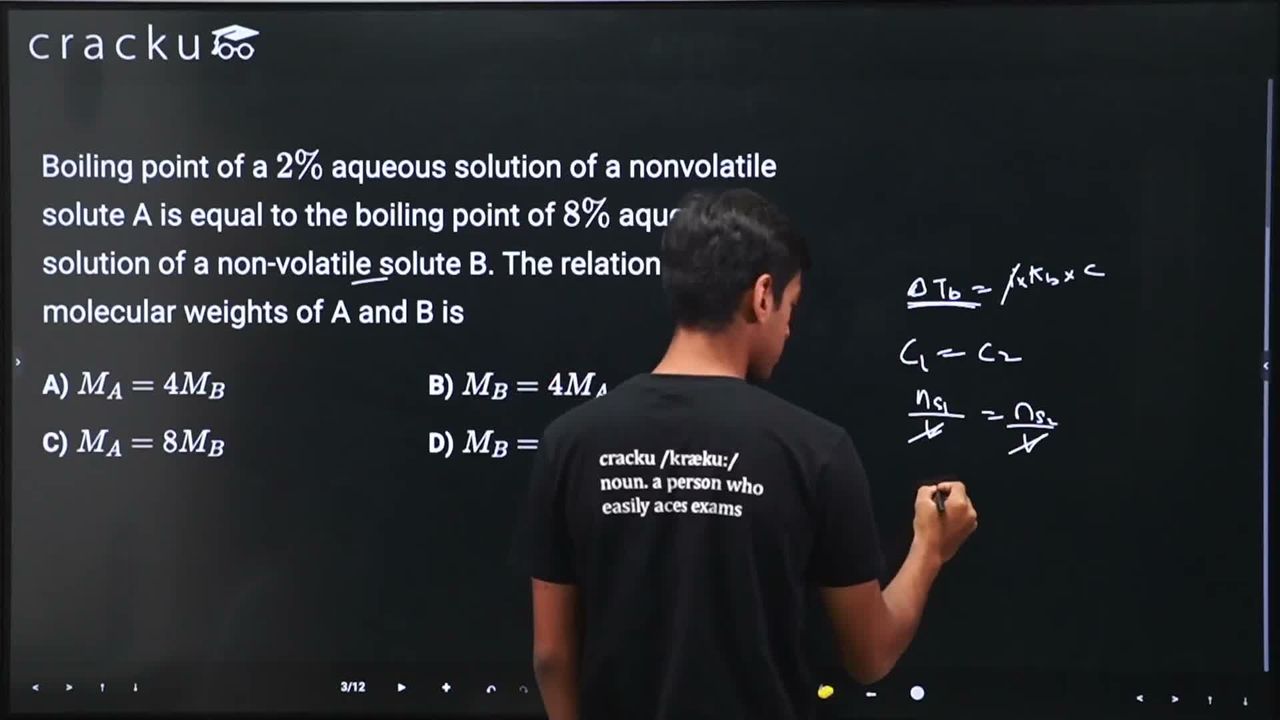
Boiling point of a $$2\%$$ aqueous solution of a nonvolatile solute A is equal to the boiling point of $$8\%$$ aqueous solution of a non-volatile solute B. The relation between molecular weights of A and B is
We are given that the boiling point of a 2% aqueous solution of a non-volatile solute A is equal to the boiling point of an 8% aqueous solution of a non-volatile solute B. We need to find the relation between their molecular weights $$M_A$$ and $$M_B$$.
Recall the boiling point elevation formula. The elevation in boiling point for a dilute solution is given by:
$$ \Delta T_b = K_b \times m $$
where $$K_b$$ is the ebullioscopic constant of the solvent and $$m$$ is the molality of the solution.
Since both solutions are aqueous, they share the same solvent (water) and hence the same $$K_b$$. Equal boiling points mean equal boiling point elevations:
$$ \Delta T_{b,A} = \Delta T_{b,B} $$
$$ K_b \times m_A = K_b \times m_B $$
Cancelling $$K_b$$ gives
$$ m_A = m_B $$
A "w%" aqueous solution means w grams of solute is dissolved in 100 grams of solution, so the mass of solvent (water) is (100 - w) grams. Molality is defined as moles of solute per kilogram of solvent:
$$ m = \frac{\text{moles of solute}}{\text{mass of solvent in kg}} = \frac{w / M}{\frac{(100 - w)}{1000}} = \frac{1000w}{M \times (100 - w)} $$
For 2% solution of A: $$ m_A = \frac{1000 \times 2}{M_A \times (100 - 2)} = \frac{2000}{98 \, M_A} $$
For 8% solution of B: $$ m_B = \frac{1000 \times 8}{M_B \times (100 - 8)} = \frac{8000}{92 \, M_B} $$
Equating these molalities and cross-multiplying yields:
$$ \frac{2000}{98 \, M_A} = \frac{8000}{92 \, M_B} $$
$$ 2000 \times 92 \times M_B = 8000 \times 98 \times M_A $$
$$ 184000 \, M_B = 784000 \, M_A $$
Dividing both sides by 184000 gives
$$ M_B = \frac{784000}{184000} \, M_A = \frac{784}{184} \, M_A $$
Simplifying the fraction:
$$ \frac{784}{184} = \frac{784 \div 8}{184 \div 8} = \frac{98}{23} \approx 4.26 $$
Applying the standard JEE approximation for dilute solutions (where the solute percentage is small) under which (100 - w) ≈ 100, we have:
$$ m_A = \frac{1000 \times 2}{M_A \times 100} = \frac{20}{M_A} $$
$$ m_B = \frac{1000 \times 8}{M_B \times 100} = \frac{80}{M_B} $$
Setting these equal,
$$ \frac{20}{M_A} = \frac{80}{M_B} $$
$$ 20 \, M_B = 80 \, M_A $$
$$ M_B = \frac{80}{20} \, M_A = 4 \, M_A $$
Therefore, $$M_B = 4M_A$$.
The correct answer is Option B: $$M_B = 4M_A$$.
Was this solution helpful?
Click on the Email ☝️ to Watch the Video Solution
Create a FREE account and get:
_1.webp)

Educational materials for JEE preparation

Ask our AI anything

AI can make mistakes. Please verify important information.
AI can make mistakes. Please verify important information.
