
Join Our JEE Preparation Group
Prep with like-minded aspirants; Get access to free daily tests and study material.
Sign in
Please select an account to continue using cracku.in
↓ →
Join Our JEE Preparation Group
Prep with like-minded aspirants; Get access to free daily tests and study material.
Which out of the following is a correct equation to show change in molar conductivity with respect to concentration for a weak electrolyte, if the symbols carry their usual meaning :
A weak electrolyte dissociates only to a small extent in solution. The fraction of the electrolyte that actually dissociates is called the degree of dissociation, denoted by $$\alpha$$.
For any weak monobasic acid or monoacidic base the Ostwald-dilution law gives $$K_a = \frac{\alpha^{2}C}{1-\alpha}$$ $$-(1)$$ where $$K_a$$ = acid (or base) dissociation constant, $$C$$ = initial molar concentration of the electrolyte.
The molar conductivity at the given concentration, $$\Lambda_m$$, is related to the molar conductivity at infinite dilution, $$\Lambda_m^{\circ}$$, through the degree of dissociation: $$\alpha = \frac{\Lambda_m}{\Lambda_m^{\circ}}$$ $$-(2)$$
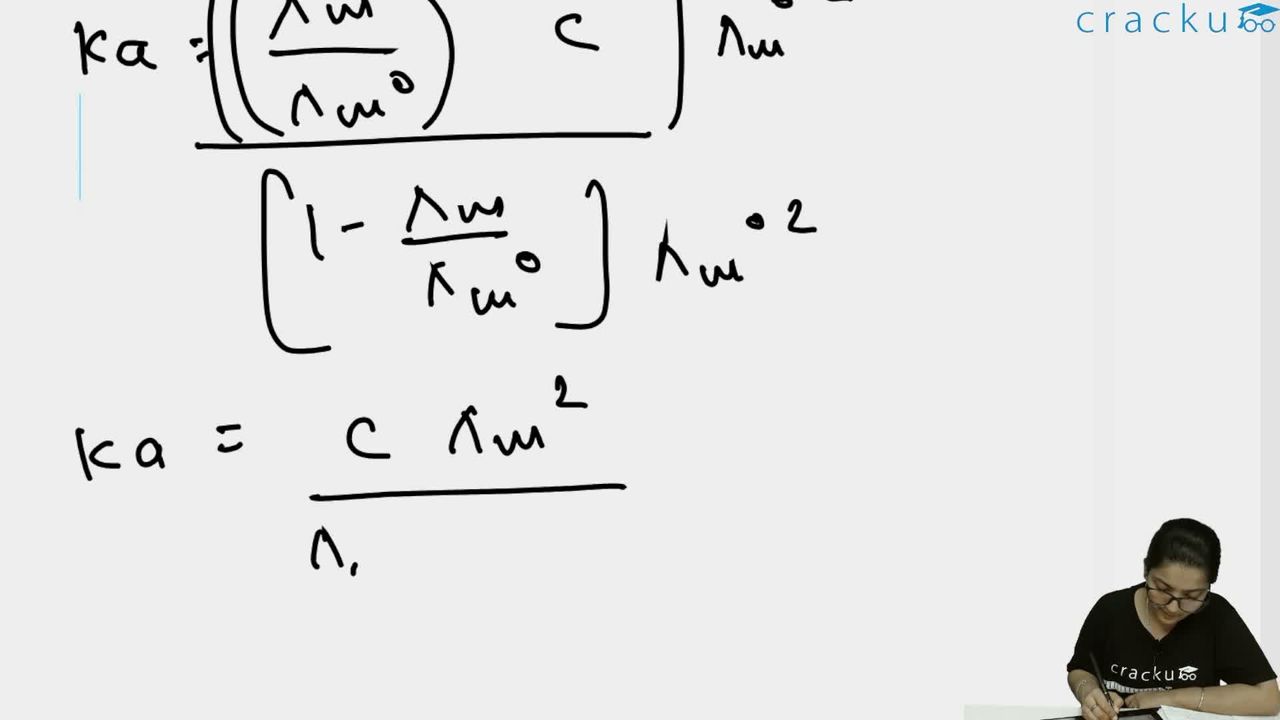
Insert $$\alpha = \dfrac{\Lambda_m}{\Lambda_m^{\circ}}$$ from $$(2)$$ into $$(1)$$:
$$K_a = \frac{\left(\dfrac{\Lambda_m}{\Lambda_m^{\circ}}\right)^2 C}{1-\dfrac{\Lambda_m}{\Lambda_m^{\circ}}}$$
Simplify the denominator and then multiply numerator & denominator by $$\Lambda_m^{\circ}$$ to clear the fraction:
$$K_a = \frac{C\Lambda_m^{2}}{\Lambda_m^{\circ 2} - \Lambda_m\Lambda_m^{\circ}}$$
Cross-multiply to obtain an equation that contains only whole-number powers:
$$K_a\bigl(\Lambda_m^{\circ 2} - \Lambda_m\Lambda_m^{\circ}\bigr) = C\Lambda_m^{2}$$
Rearrange every term to the left-hand side:
$$\Lambda_m^{2}C - K_a\Lambda_m^{\circ 2} + K_a\Lambda_m\Lambda_m^{\circ} = 0$$
This is the required relation between molar conductivity and concentration for a weak electrolyte.
Comparison with the given options shows that it matches Option B.
Hence, the correct choice is Option B.
Was this solution helpful?
Click on the Email ☝️ to Watch the Video Solution
Create a FREE account and get:


Educational materials for JEE preparation

Ask our AI anything

AI can make mistakes. Please verify important information.
AI can make mistakes. Please verify important information.
