
Join Our JEE Preparation Group
Prep with like-minded aspirants; Get access to free daily tests and study material.
Sign in
Please select an account to continue using cracku.in
↓ →
Join Our JEE Preparation Group
Prep with like-minded aspirants; Get access to free daily tests and study material.
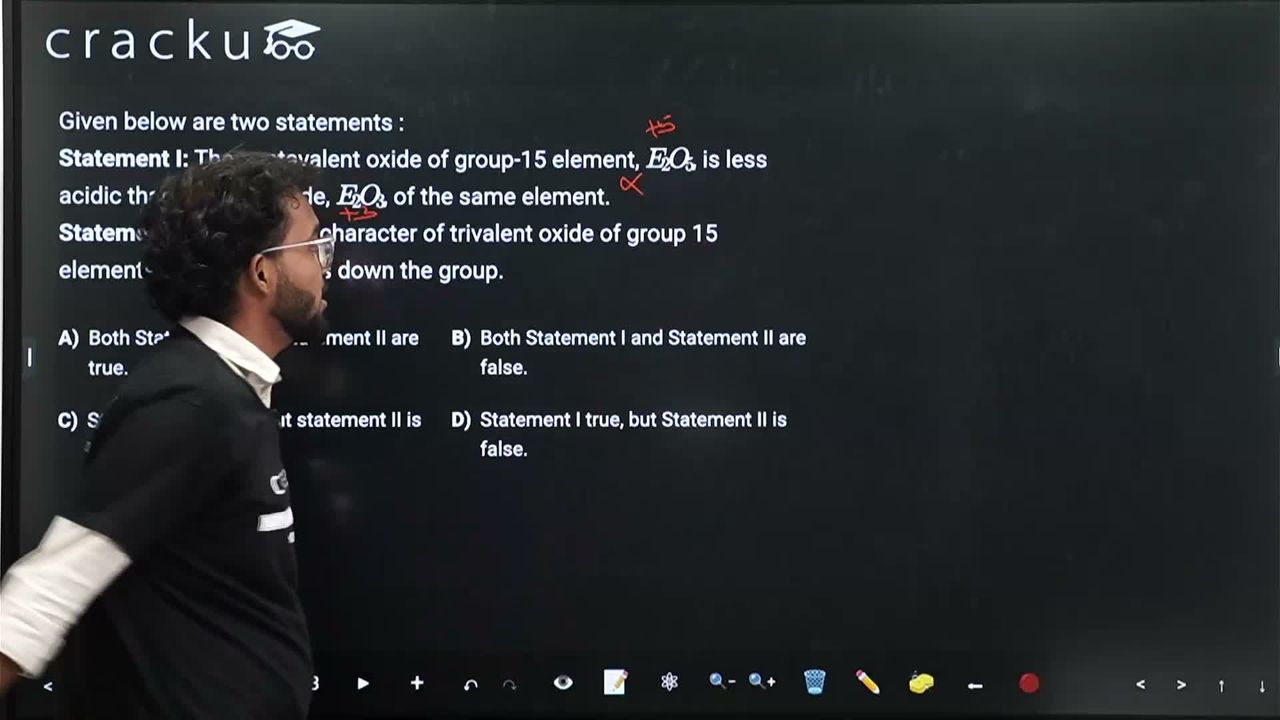
Given below are two statements :
Statement I: The pentavalent oxide of group-15 element, $$E_2O_5$$, is less acidic than trivalent oxide, $$E_2O_3$$, of the same element.
Statement II : The acidic character of trivalent oxide of group 15 elements, $$E_2O_3$$, decreases down the group.
We need to evaluate both statements about oxides of Group 15 elements.
Statement I: The pentavalent oxide $$E_2O_5$$ is less acidic than the trivalent oxide $$E_2O_3$$ of the same element.
In general, the higher the oxidation state of the central atom, the more acidic the oxide. This is because a higher oxidation state means a greater positive charge on the central atom, which makes it attract electron density from the O-H bond more strongly, facilitating the release of $$H^+$$ ions.
For Group 15 elements:
- In $$E_2O_5$$, the oxidation state of E is +5
- In $$E_2O_3$$, the oxidation state of E is +3
Since higher oxidation state leads to more acidic character, $$E_2O_5$$ is more acidic than $$E_2O_3$$, not less.
Therefore, Statement I is FALSE.
Statement II: The acidic character of trivalent oxide $$E_2O_3$$ decreases down the group.
As we go down Group 15 (N → P → As → Sb → Bi):
- The electronegativity of the element decreases
- The metallic character increases
- The oxides change from acidic → amphoteric → basic
For trivalent oxides specifically:
- $$N_2O_3$$ — acidic
- $$P_2O_3$$ — acidic
- $$As_2O_3$$ — amphoteric
- $$Sb_2O_3$$ — amphoteric
- $$Bi_2O_3$$ — basic
The acidic character clearly decreases down the group.
Therefore, Statement II is TRUE.
The correct answer is Option C: Statement I is false but Statement II is true.
Was this solution helpful?
Click on the Email ☝️ to Watch the Video Solution
Create a FREE account and get:
_1.webp)

Educational materials for JEE preparation

Ask our AI anything

AI can make mistakes. Please verify important information.
AI can make mistakes. Please verify important information.
