
Join Our JEE Preparation Group
Prep with like-minded aspirants; Get access to free daily tests and study material.
Sign in
Please select an account to continue using cracku.in
↓ →
Join Our JEE Preparation Group
Prep with like-minded aspirants; Get access to free daily tests and study material.
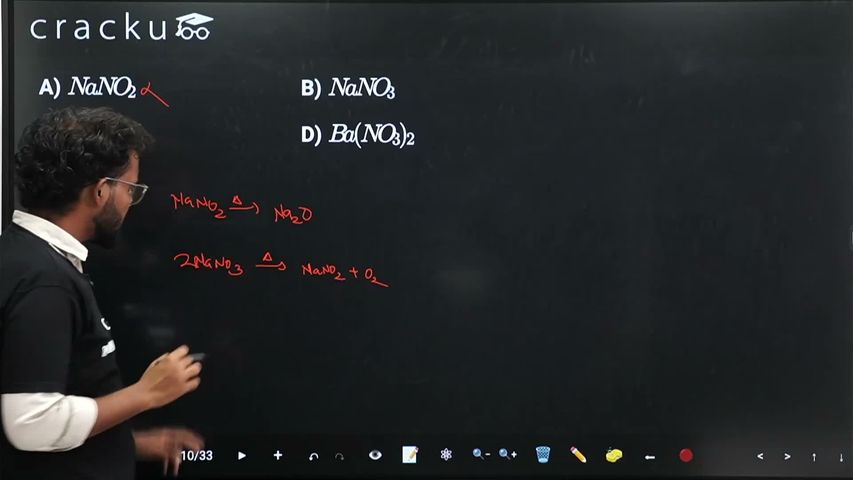
We need to identify which compound gives nitrogen gas ($$N_2$$) on thermal decomposition. Option A: $$NaNO_2$$ (Sodium nitrite) decomposes on heating but does not produce $$N_2$$ gas directly; it can decompose to give $$Na_2O$$, $$NO$$, and $$NO_2$$.
Option B: $$NaNO_3$$ (Sodium nitrate) decomposes on heating as:
$$2NaNO_3 \xrightarrow{\Delta} 2NaNO_2 + O_2$$
This gives oxygen gas, not nitrogen gas.
Option C: $$Ba(N_3)_2$$ (Barium azide) decomposes on heating as:
$$Ba(N_3)_2 \xrightarrow{\Delta} Ba + 3N_2$$
This gives pure nitrogen gas ($$N_2$$).
Option D: $$Ba(NO_3)_2$$ (Barium nitrate) decomposes on heating as:
$$2Ba(NO_3)_2 \xrightarrow{\Delta} 2BaO + 4NO_2 + O_2$$
This gives $$NO_2$$ and $$O_2$$, not $$N_2$$.
Azides ($$N_3^-$$) are compounds that contain three nitrogen atoms bonded together; on thermal decomposition, they readily release nitrogen gas ($$N_2$$). Barium azide is a well-known source of pure nitrogen gas upon heating. The correct answer is Option C: $$Ba(N_3)_2$$.
Was this solution helpful?
Click on the Email ☝️ to Watch the Video Solution
Create a FREE account and get:
_1.webp)

Educational materials for JEE preparation

Ask our AI anything

AI can make mistakes. Please verify important information.
AI can make mistakes. Please verify important information.
