
Join Our JEE Preparation Group
Prep with like-minded aspirants; Get access to free daily tests and study material.
Sign in
Please select an account to continue using cracku.in
↓ →
Join Our JEE Preparation Group
Prep with like-minded aspirants; Get access to free daily tests and study material.
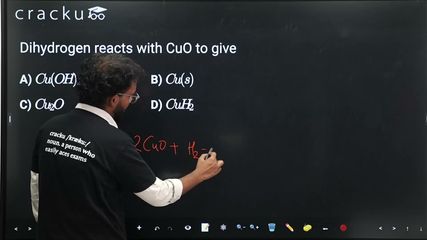
We need to determine the product when dihydrogen ($$H_2$$) reacts with copper(II) oxide ($$CuO$$). Hydrogen gas is a reducing agent; when it reacts with metal oxides, it reduces the metal oxide, so this redox reaction involves $$H_2$$ acting as a reducing agent and $$CuO$$ getting reduced.
$$CuO(s) + H_2(g) \xrightarrow{\Delta} Cu(s) + H_2O(l)$$
Copper in $$CuO$$ has an oxidation state of +2, hydrogen reduces $$Cu^{2+}$$ to $$Cu^0$$ (metallic copper) and is itself oxidized from 0 to +1 in $$H_2O$$. This reaction is used as a standard test for the reducing property of hydrogen gas. When $$H_2$$ is passed over heated $$CuO$$ (black), the black powder turns reddish-brown as metallic copper ($$Cu$$) is formed.
Other possible products such as $$Cu(OH)_2$$ would require an aqueous base environment rather than a direct reaction of $$H_2$$ with $$CuO$$; $$Cu_2O$$ would indicate partial reduction, but $$H_2$$ completely reduces $$CuO$$ to metallic $$Cu$$; and copper hydride ($$CuH_2$$) is not formed under these conditions.
Therefore, the correct answer is Option B: $$Cu(s)$$.
Was this solution helpful?
Click on the Email ☝️ to Watch the Video Solution
Create a FREE account and get:
_1.webp)

Educational materials for JEE preparation

Ask our AI anything

AI can make mistakes. Please verify important information.
AI can make mistakes. Please verify important information.
