
Join Our JEE Preparation Group
Prep with like-minded aspirants; Get access to free daily tests and study material.
Sign in
Please select an account to continue using cracku.in
↓ →
Join Our JEE Preparation Group
Prep with like-minded aspirants; Get access to free daily tests and study material.
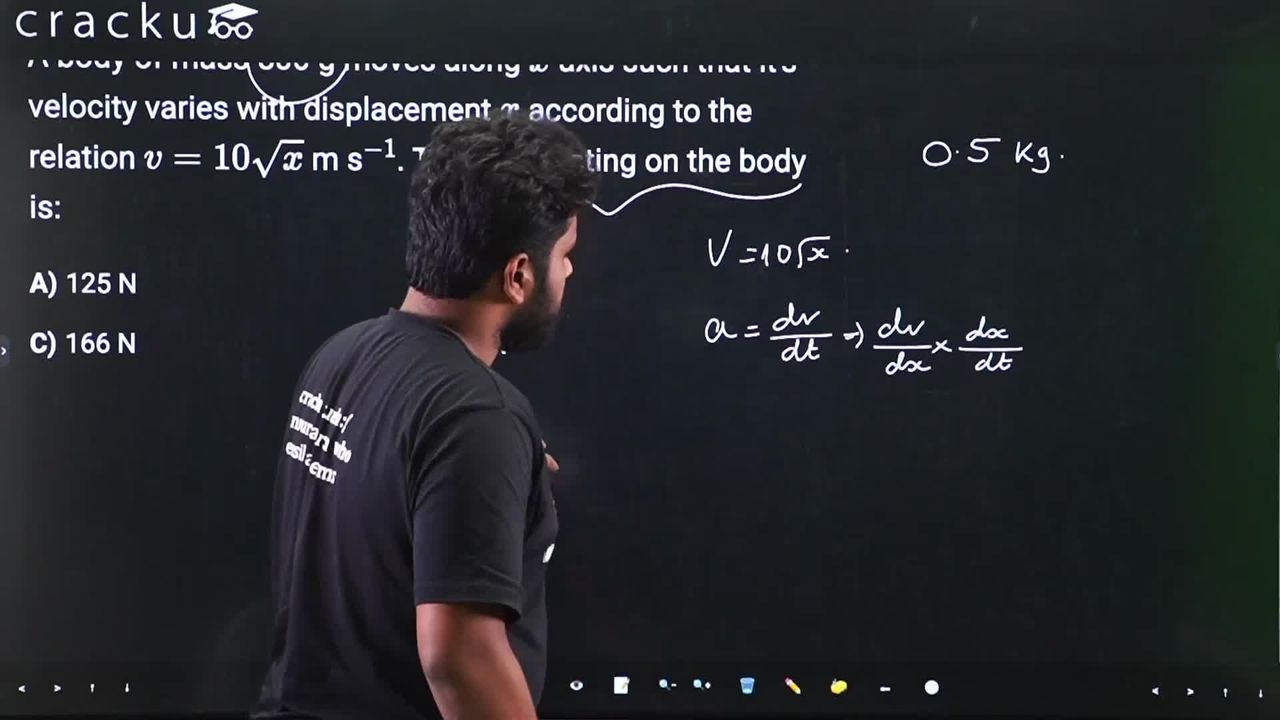
A body of mass 500 g moves along $$x$$-axis such that it's velocity varies with displacement $$x$$ according to the relation $$v = 10\sqrt{x}$$ m s$$^{-1}$$. The force acting on the body is:
A body of mass 500 g moves along the x-axis with velocity $$v = 10\sqrt{x}$$ m/s. We need to find the force acting on it.
First, we state the given quantities.
Mass: $$m = 500$$ g $$= 0.5$$ kg
Velocity as a function of displacement: $$v = 10\sqrt{x} = 10x^{1/2}$$ m/s
Next, we find the acceleration using the chain rule.
Since velocity is given as a function of position (not time), we use the relation:
$$ a = v\frac{dv}{dx} $$
This follows from the chain rule: $$a = \frac{dv}{dt} = \frac{dv}{dx} \cdot \frac{dx}{dt} = \frac{dv}{dx} \cdot v$$.
First, find $$\frac{dv}{dx}$$:
$$ \frac{dv}{dx} = \frac{d}{dx}(10x^{1/2}) = 10 \times \frac{1}{2}x^{-1/2} = \frac{5}{\sqrt{x}} $$
Now compute the acceleration:
$$ a = v \cdot \frac{dv}{dx} = 10\sqrt{x} \times \frac{5}{\sqrt{x}} = 50\;\text{m/s}^2 $$
Notice that the $$\sqrt{x}$$ terms cancel, giving a constant acceleration independent of position.
From this, we apply Newton's second law.
$$ F = ma = 0.5 \times 50 = 25\;\text{N} $$
The force acting on the body is 25 N.
The correct answer is Option 2: 25 N.
Was this solution helpful?
Click on the Email ☝️ to Watch the Video Solution
Create a FREE account and get:
_1.webp)

Educational materials for JEE preparation

Ask our AI anything

AI can make mistakes. Please verify important information.
AI can make mistakes. Please verify important information.


