
Join Our JEE Preparation Group
Prep with like-minded aspirants; Get access to free daily tests and study material.
Sign in
Please select an account to continue using cracku.in
↓ →
Join Our JEE Preparation Group
Prep with like-minded aspirants; Get access to free daily tests and study material.
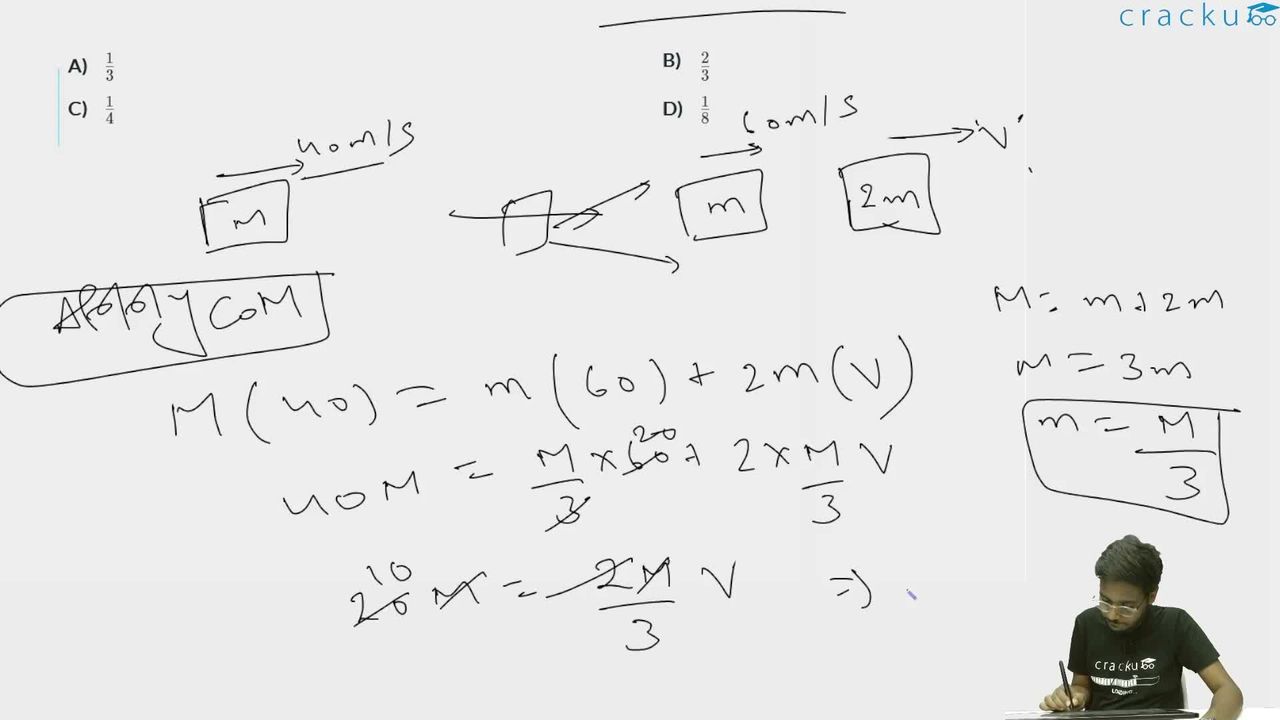
A block moving horizontally on a smooth surface with a speed of 40 m s$$^{-1}$$ splits into two parts with masses in the ratio of 1 : 2. If the smaller part moves at 60 m s$$^{-1}$$ in the same direction, then the fractional change in kinetic energy is:
Let the original mass of the single block be $$M$$ and its initial speed be $$u = 40\ \text{m s}^{-1}$$. The initial kinetic energy is given by the formula $$K = \dfrac12 m v^{2}$$, so we have
$$K_i = \dfrac12\,M\,u^{2} = \dfrac12\,M\,(40)^{2} = \dfrac12\,M\,(1600) = 800\,M.$$
The block breaks into two pieces whose masses are in the ratio $$1:2$$. We denote the smaller mass by $$m$$ and the larger mass by $$2m$$. Because the total mass must remain the same,
$$m + 2m = 3m = M \;\;\Longrightarrow\;\; m = \dfrac{M}{3}, \qquad 2m = \dfrac{2M}{3}.$$
The problem states that the smaller piece moves forward with speed $$v_1 = 60\ \text{m s}^{-1}$$. We still have to find the speed $$v_2$$ of the larger piece.
The surface is smooth, so no external horizontal force acts on the system; therefore linear momentum is conserved. The law of conservation of momentum says
$$\text{(total momentum before)} = \text{(total momentum after)}.$$
This gives
$$M\,u = m\,v_1 + (2m)\,v_2.$$
Substituting $$u = 40\ \text{m s}^{-1}$$, $$m = \dfrac{M}{3}$$ and $$v_1 = 60\ \text{m s}^{-1}$$, we obtain
$$M(40) = \dfrac{M}{3}(60) + \dfrac{2M}{3}\,v_2.$$
Dividing every term by $$M$$ to cancel the common factor,
$$40 = \dfrac{60}{3} + \dfrac{2}{3}\,v_2.$$
Since $$\dfrac{60}{3} = 20$$, we have
$$40 = 20 + \dfrac{2}{3}\,v_2 \;\;\Longrightarrow\;\; 40 - 20 = \dfrac{2}{3}\,v_2 \;\;\Longrightarrow\;\; 20 = \dfrac{2}{3}\,v_2.$$
Multiplying both sides by $$\dfrac{3}{2}$$ to isolate $$v_2$$, we find
$$v_2 = 20\left(\dfrac{3}{2}\right) = 30\ \text{m s}^{-1}.$$
Now we calculate the kinetic energy after the split. Using $$K = \dfrac12 m v^{2}$$ for each part,
$$\begin{aligned} K_f &= \dfrac12\,m\,v_1^{2} + \dfrac12\,(2m)\,v_2^{2} \\ &= \dfrac12\left(\dfrac{M}{3}\right)(60)^{2} + \dfrac12\left(\dfrac{2M}{3}\right)(30)^{2}. \end{aligned}$$
Simplifying each term one at a time:
First term:
$$\dfrac12\left(\dfrac{M}{3}\right)(60)^{2} = \dfrac{M}{6}\,(3600) = 600\,M.$$
Second term:
$$\dfrac12\left(\dfrac{2M}{3}\right)(30)^{2} = \dfrac{M}{3}\,(900) = 300\,M.$$
Adding these contributions gives
$$K_f = 600\,M + 300\,M = 900\,M.$$
The change in kinetic energy is
$$\Delta K = K_f - K_i = 900\,M - 800\,M = 100\,M.$$
The fractional change in kinetic energy is the ratio $$\dfrac{\Delta K}{K_i}$$, so
$$\dfrac{\Delta K}{K_i} = \dfrac{100\,M}{800\,M} = \dfrac{1}{8}.$$
Hence, the correct answer is Option D.
Was this solution helpful?
Click on the Email ☝️ to Watch the Video Solution
Create a FREE account and get:
_1.webp)

Educational materials for JEE preparation

Ask our AI anything

AI can make mistakes. Please verify important information.
AI can make mistakes. Please verify important information.
