
Join Our JEE Preparation Group
Prep with like-minded aspirants; Get access to free daily tests and study material.
Sign in
Please select an account to continue using cracku.in
↓ →
Join Our JEE Preparation Group
Prep with like-minded aspirants; Get access to free daily tests and study material.
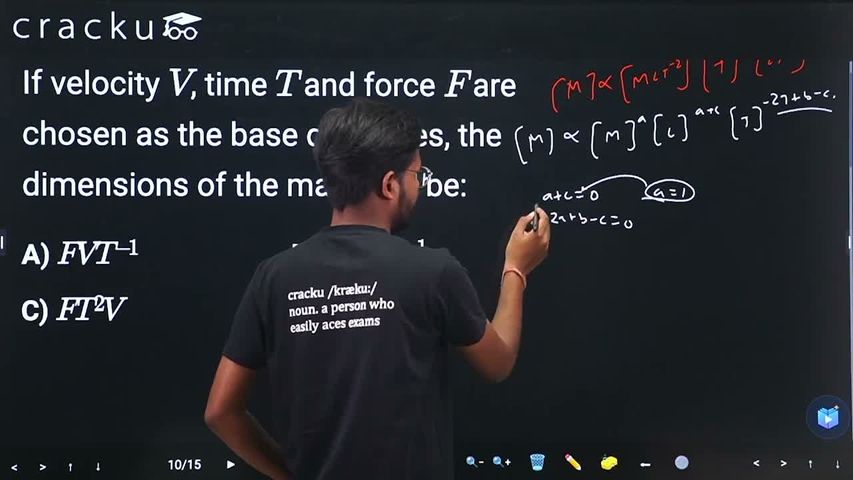
If velocity $$V$$, time $$T$$ and force $$F$$ are chosen as the base quantities, the dimensions of the mass will be:
We begin with Newton’s second law, which states that the force acting on a body equals the product of its mass and its acceleration:
$$F = M \, a$$
Acceleration is defined as the rate of change of velocity with respect to time, so its dimensional formula in the usual $$L,\,T$$ system is
$$a = \frac{\text{velocity}}{\text{time}} \;\;\Rightarrow\;\; [a] = L\,T^{-2}.$$
However, in the present problem velocity $$V$$, time $$T$$ and force $$F$$ have been declared the fundamental (base) quantities. We must therefore replace every appearance of length $$L$$ and mass $$M$$ by combinations of $$F,\;V,\;T$$ only.
First we eliminate length $$L$$. The definition of velocity is
$$V = \frac{L}{T}\quad\Longrightarrow\quad L = V\,T.$$
Now insert this expression for $$L$$ into the dimensional formula of acceleration:
$$[a] = L\,T^{-2} = (V\,T)\,T^{-2} = V\,T^{-1}.$$
Thus, expressed through the chosen base quantities, acceleration has the dimensions $$V\,T^{-1}.$$
Return to Newton’s second law. Writing its dimensional form with the new base quantities gives
$$[F] = [M]\,[a] \;=\; [M]\,(V\,T^{-1}).$$
To isolate the dimensional formula of mass $$M$$, simply divide both sides by the factor $$V\,T^{-1}$$:
$$[M] = [F]\,(V\,T^{-1})^{-1}.$$
Because $$\bigl(V\,T^{-1}\bigr)^{-1} = V^{-1}\,T,$$ we have
$$[M] = F\,T\,V^{-1}.$$
This means the mass dimension in the $$F,\,V,\,T$$ system is $$F\,T\,V^{-1}.$$ Hence, the correct answer is Option D.
Click on the Email ☝️ to Watch the Video Solution
Create a FREE account and get:
_1.webp)

Educational materials for JEE preparation

Ask our AI anything

AI can make mistakes. Please verify important information.
AI can make mistakes. Please verify important information.


