
Join Our JEE Preparation Group
Prep with like-minded aspirants; Get access to free daily tests and study material.
Sign in
Please select an account to continue using cracku.in
↓ →
Join Our JEE Preparation Group
Prep with like-minded aspirants; Get access to free daily tests and study material.
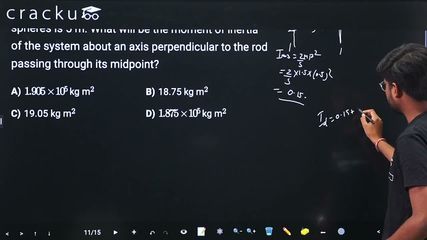
A system consists of two identical spheres each of mass 1.5 kg and radius 50 cm at the ends of a light rod. The distance between the centres of the two spheres is 5 m. What will be the moment of inertia of the system about an axis perpendicular to the rod passing through its midpoint?
We are asked to find the moment of inertia of the whole system about an axis that is perpendicular to the light rod and passes through the midpoint of the rod. The system consists of two identical solid spheres attached to the two ends of the rod, so we have to calculate the contribution of each sphere and then add the two contributions.
First, recall the two formulas we will need:
1. For a solid sphere about its own centre, the moment of inertia is given by $$I_{\text{cm}}=\dfrac{2}{5}\,mR^{2}.$$
2. The parallel-axis theorem (Steiner’s theorem) states that if an axis is displaced from the centre of mass by a distance $$d,$$ then the new moment of inertia is $$I = I_{\text{cm}} + m d^{2}.$$
Now we insert the numerical data. For each sphere:
Mass: $$m = 1.5\ \text{kg}.$$
Radius: $$R = 50\ \text{cm} = 0.5\ \text{m}.$$
The moment of inertia about its own centre is therefore
$$I_{\text{cm}} = \dfrac{2}{5}\,mR^{2} = \dfrac{2}{5}\,(1.5)\,(0.5)^{2}.$$
We calculate step by step:
$$(0.5)^{2} = 0.25,$$
$$\dfrac{2}{5} = 0.4,$$
$$0.4 \times 0.25 = 0.10,$$
$$0.10 \times 1.5 = 0.15.$$
So $$I_{\text{cm}} = 0.15\ \text{kg m}^{2}.$$
The distance of the centre of each sphere from the given axis: the two centres are 5 m apart, and the axis is at the midpoint of the rod, so each centre is
$$d = \dfrac{5\ \text{m}}{2} = 2.5\ \text{m}$$
away from the axis.
Using the parallel-axis theorem, the moment of inertia of one sphere about the required axis is
$$I_{\text{one}} = I_{\text{cm}} + m d^{2} = 0.15 + (1.5)(2.5)^{2}.$$
Calculating the term $$m d^{2}:$$
$$d^{2} = (2.5)^{2} = 6.25,$$
$$m d^{2} = 1.5 \times 6.25 = 9.375.$$
Adding $$I_{\text{cm}}$$ to this:
$$I_{\text{one}} = 0.15 + 9.375 = 9.525\ \text{kg m}^{2}.$$
Because there are two identical spheres, the total moment of inertia of the system is
$$I_{\text{total}} = 2\,I_{\text{one}} = 2 \times 9.525 = 19.05\ \text{kg m}^{2}.$$
Hence, the correct answer is Option C.
Was this solution helpful?
Click on the Email ☝️ to Watch the Video Solution
Create a FREE account and get:
_1.webp)

Educational materials for JEE preparation

Ask our AI anything

AI can make mistakes. Please verify important information.
AI can make mistakes. Please verify important information.
