
Join Our JEE Preparation Group
Prep with like-minded aspirants; Get access to free daily tests and study material.
Sign in
Please select an account to continue using cracku.in
↓ →
Join Our JEE Preparation Group
Prep with like-minded aspirants; Get access to free daily tests and study material.
Given below are two statements, one is labelled as Assertion A and the other is labelled as Reason R.
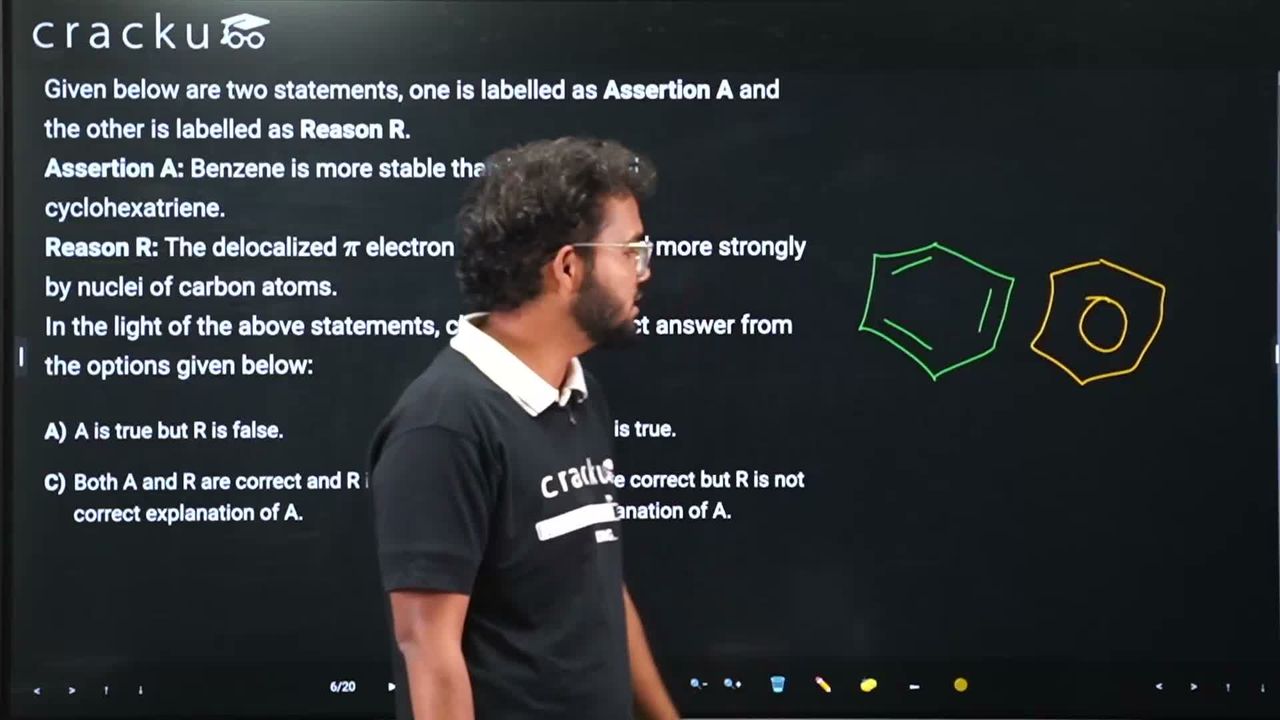
Assertion A: Benzene is more stable than hypothetical cyclohexatriene.
Reason R: The delocalized $$\pi$$ electron cloud is attracted more strongly by nuclei of carbon atoms.
In the light of the above statements, choose the correct answer from the options given below:
This is an Assertion-Reason type question. We need to evaluate both statements independently and determine their truth values and relationship.
Evaluating Assertion A: "Benzene is more stable than hypothetical cyclohexatriene."
Cyclohexatriene is a hypothetical molecule with three isolated, localized C=C double bonds in a six-membered ring (i.e., without any resonance stabilization). In contrast, real benzene has a fully delocalized pi-electron system where the six pi electrons are spread over all six carbon atoms.
The experimental evidence for benzene's extra stability comes from its heat of hydrogenation. Cyclohexene (one C=C bond) has a heat of hydrogenation of about 120 kJ/mol. If cyclohexatriene existed with three isolated double bonds, its expected heat of hydrogenation would be $$3 \times 120 = 360$$ kJ/mol. However, the actual heat of hydrogenation of benzene is only about 208 kJ/mol. The difference, $$360 - 208 = 152$$ kJ/mol (approximately 36 kcal/mol), is called the resonance energy of benzene.
This large resonance stabilization energy confirms that benzene is indeed significantly more stable than the hypothetical cyclohexatriene. Assertion A is TRUE.
Evaluating Reason R: "The delocalized pi electron cloud is attracted more strongly by nuclei of carbon atoms."
This statement is false. The stability of benzene over cyclohexatriene is not due to the pi electrons being "attracted more strongly" by the carbon nuclei. The actual reason for benzene's enhanced stability is the delocalization of pi electrons over the entire ring. When electrons are delocalized over a larger region, their kinetic energy decreases (the electron wavelength increases and momentum decreases, by the uncertainty principle), and the overall electronic energy is lowered. This is the origin of resonance energy.
The nuclear attraction for electrons does not fundamentally change between benzene and cyclohexatriene -- both have the same number of carbon nuclei and pi electrons. The key difference is the delocalization that lowers the total energy of the system. Reason R is FALSE.
Since A is true and R is false, the correct answer is Option 1: A is true but R is false.
Was this solution helpful?
Click on the Email ☝️ to Watch the Video Solution
Create a FREE account and get:
_1.webp)

Educational materials for JEE preparation

Ask our AI anything

AI can make mistakes. Please verify important information.
AI can make mistakes. Please verify important information.
