
Join Our JEE Preparation Group
Prep with like-minded aspirants; Get access to free daily tests and study material.
Sign in
Please select an account to continue using cracku.in
↓ →
Join Our JEE Preparation Group
Prep with like-minded aspirants; Get access to free daily tests and study material.
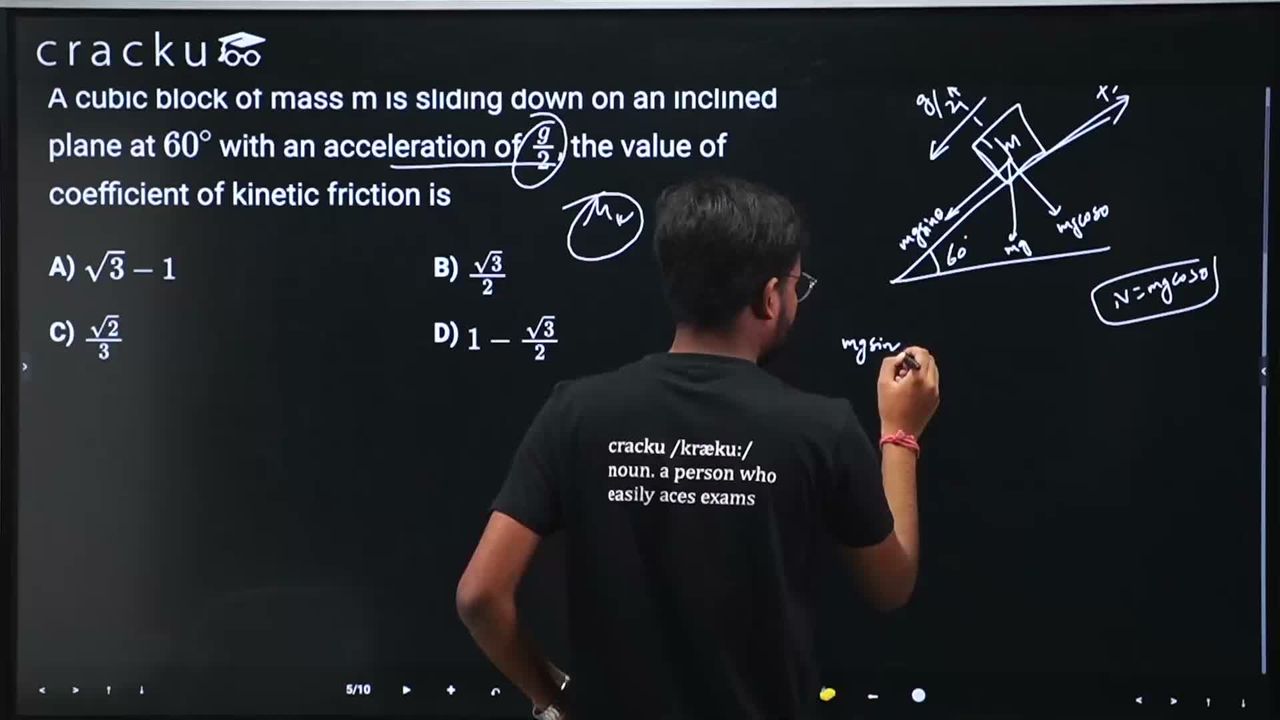
A cubic block of mass m is sliding down on an inclined plane at $$60^{\circ}$$ with an acceleration of $$\frac{g}{2}$$, the value of coefficient of kinetic friction is
The block slides down a rough plane making an angle $$\theta = 60^{\circ}$$ with the horizontal.
For a body sliding down an inclined plane, the forces along (parallel to) the plane are:
• Down the plane: component of weight, $$mg\sin\theta$$
• Up the plane: kinetic friction, $$f_k = \mu_k N$$, where $$N$$ is the normal reaction.
First find the normal reaction. For an incline, $$N = mg\cos\theta$$ because no acceleration is perpendicular to the plane.
Therefore the kinetic friction magnitude is
$$f_k = \mu_k N = \mu_k mg\cos\theta$$.
Apply Newton’s second law along the plane (taking down the plane as positive).
Net force $$= mg\sin\theta - f_k = ma$$.
Substitute $$f_k$$ and the given acceleration $$a = \dfrac{g}{2}$$:
$$mg\sin\theta - \mu_k mg\cos\theta = m\left(\dfrac{g}{2}\right)$$.
Cancel the common factor $$mg$$ from every term:
$$\sin\theta - \mu_k \cos\theta = \dfrac{1}{2}$$ $$-(1)$$
Insert the trigonometric values for $$\theta = 60^{\circ}$$:
$$\sin 60^{\circ} = \dfrac{\sqrt{3}}{2}, \qquad \cos 60^{\circ} = \dfrac{1}{2}$$.
Equation $$(1)$$ becomes
$$\dfrac{\sqrt{3}}{2} - \mu_k \left(\dfrac{1}{2}\right) = \dfrac{1}{2}$$.
Multiply every term by 2 to remove the denominators:
$$\sqrt{3} - \mu_k = 1$$.
Solve for $$\mu_k$$:
$$\mu_k = \sqrt{3} - 1$$.
Hence the coefficient of kinetic friction is $$\sqrt{3} - 1$$, which matches Option A.
Answer: Option A
Click on the Email ☝️ to Watch the Video Solution
Create a FREE account and get:
_1.webp)

Educational materials for JEE preparation

Ask our AI anything

AI can make mistakes. Please verify important information.
AI can make mistakes. Please verify important information.


