
Join Our JEE Preparation Group
Prep with like-minded aspirants; Get access to free daily tests and study material.
Sign in
Please select an account to continue using cracku.in
↓ →
Join Our JEE Preparation Group
Prep with like-minded aspirants; Get access to free daily tests and study material.
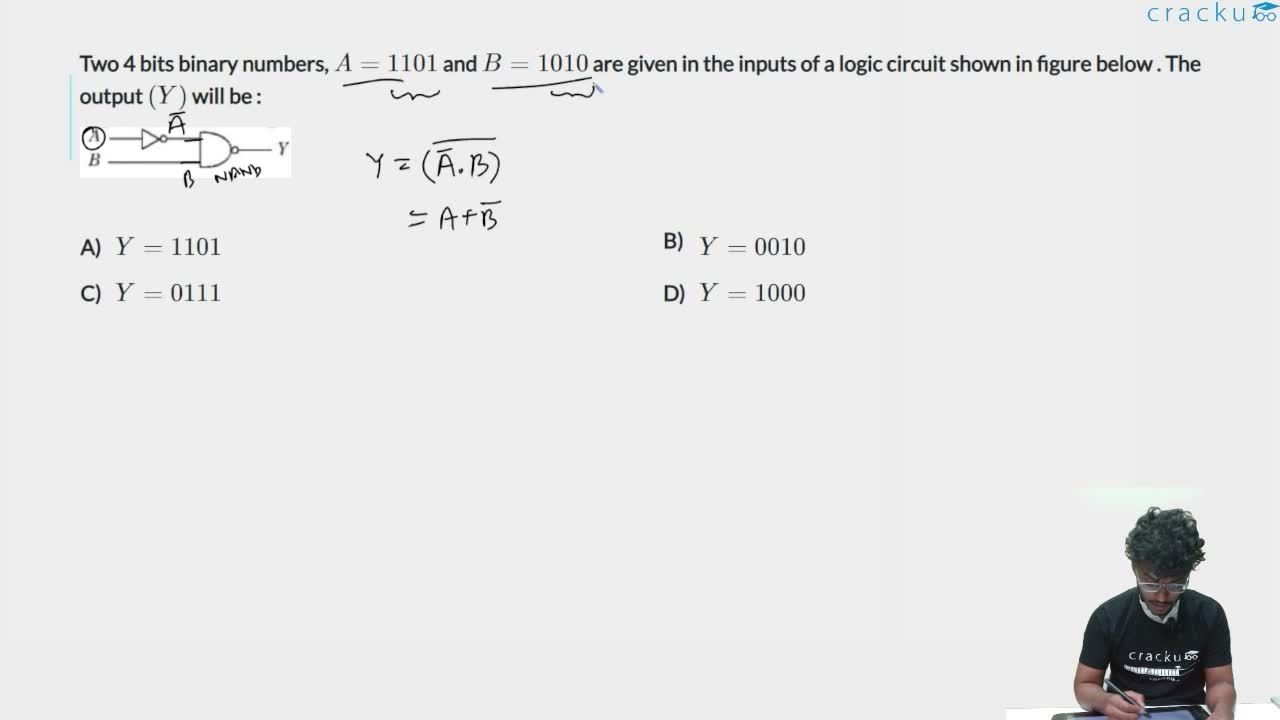
Two 4 bits binary numbers, $$A = 1101$$ and $$B = 1010$$ are given in the inputs of a logic circuit shown in figure below . The output $$(Y)$$ will be :
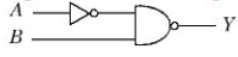
The input $$A$$ passes through a NOT gate, resulting in $$\overline{A}$$.
This signal ($$\overline{A}$$) and the input $$B$$ are fed into a NAND gate.
Therefore, the boolean expression for the output $$Y$$ is:
$$ Y = \overline{\overline{A} \cdot B} $$
According to De Morgan's Law, $\overline{X \cdot Y} = \overline{X} + \overline{Y}$. Applying this to our expression:
$$ Y = \overline{\overline{A}} + \overline{B} $$
Since the double complement of a variable is the variable itself ($\overline{\overline{A}} = A$):
$$ Y = A + \overline{B} $$
This means the output $Y$ is the bitwise OR operation of $A$ and the 1's complement of $B$.
Given the inputs:
$$ A = 1101 $$
$$ B = 1010 $$
First, find the 1's complement (bitwise NOT) of $B$:
$$ \overline{B} = 0101 $$
Next, perform the bitwise OR addition ($$+$$) of $$A$$ and $$\overline{B}$$:
Y= 1101
Was this solution helpful?
Click on the Email ☝️ to Watch the Video Solution
Create a FREE account and get:
_1.webp)

Educational materials for JEE preparation

Ask our AI anything

AI can make mistakes. Please verify important information.
AI can make mistakes. Please verify important information.


