
Join Our JEE Preparation Group
Prep with like-minded aspirants; Get access to free daily tests and study material.
Sign in
Please select an account to continue using cracku.in
↓ →
Join Our JEE Preparation Group
Prep with like-minded aspirants; Get access to free daily tests and study material.
A rod of length 10 cm lies along the principal axis of a concave mirror of focal length 10 cm as shown in figure. The length of the image is _____ cm.
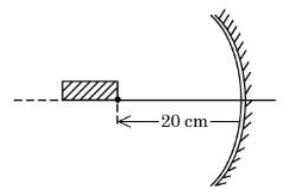
Let the concave mirror be taken as the origin of the coordinate system and the principal axis be the positive x-axis extending to the left of the mirror (Cartesian sign convention).
Hence every object distance is negative and every real image distance is also negative. We shall finally use magnitudes for the required lengths.
Focal length of the concave mirror: $$f = -10\ \text{cm}$$
The rod of length 10 cm is kept along the principal axis so that its nearer end $$A$$ is 20 cm from the pole of the mirror and its farther end $$B$$ is 30 cm from the pole.
Therefore, using sign convention,
$$u_A = -20\ \text{cm}, \qquad u_B = -30\ \text{cm}$$
For each end we apply the mirror formula
$$\frac{1}{v} + \frac{1}{u} = \frac{1}{f} \qquad -(1)$$
Image of end A
Substituting $$u = u_A = -20\ \text{cm}$$ in (1):
$$\frac{1}{v_A} + \frac{1}{-20} = \frac{1}{-10}$$
$$\frac{1}{v_A} = \frac{1}{-10} + \frac{1}{20} = \frac{-2 + 1}{20} = -\frac{1}{20}$$
$$v_A = -20\ \text{cm}$$
Image of end B
Substituting $$u = u_B = -30\ \text{cm}$$ in (1):
$$\frac{1}{v_B} + \frac{1}{-30} = \frac{1}{-10}$$
$$\frac{1}{v_B} = \frac{1}{-10} + \frac{1}{30} = \frac{-3 + 1}{30} = -\frac{2}{30} = -\frac{1}{15}$$
$$v_B = -15\ \text{cm}$$
Both images are real and lie on the principal axis in front of the mirror. Their separation (length of the image of the rod) is the difference in the magnitudes of $$v_A$$ and $$v_B$$:
$$\text{Image length} = |v_A| - |v_B| = 20\ \text{cm} - 15\ \text{cm} = 5\ \text{cm}$$
Hence the length of the image is 5 cm.
Option B which is: $$5$$
Was this solution helpful?

Click on the Email ☝️ to Watch the Video Solution
Create a FREE account and get:
_1.webp)

Educational materials for JEE preparation

Ask our AI anything

AI can make mistakes. Please verify important information.
AI can make mistakes. Please verify important information.


