
Join Our JEE Preparation Group
Prep with like-minded aspirants; Get access to free daily tests and study material.
Sign in
Please select an account to continue using cracku.in
↓ →
Join Our JEE Preparation Group
Prep with like-minded aspirants; Get access to free daily tests and study material.
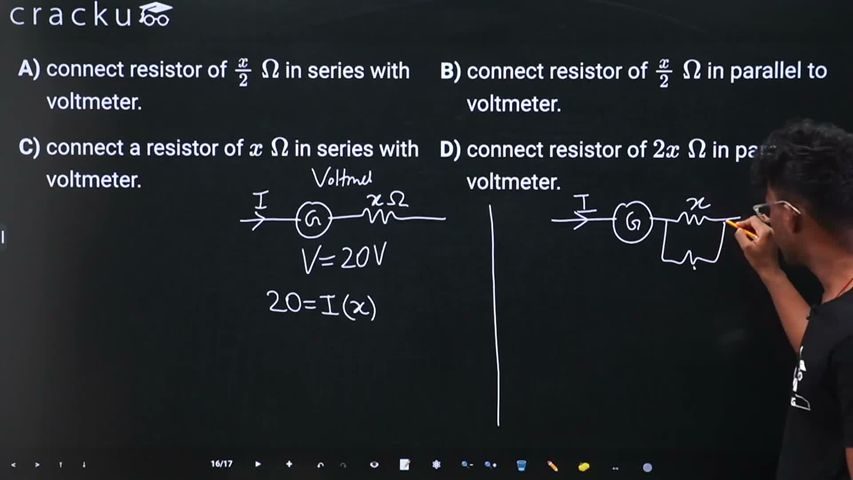
A voltmeter with internal resistance of $$x \; \Omega$$ can be used to measure upto 20 V. In order to increase its measuring range to 30 V, the required modification is :
A voltmeter is basically a galvanometer designed to draw as little current as possible from the circuit under test. Its scale is calibrated such that the full-scale deflection occurs when the potential difference across its own (internal) resistance is equal to the rated range.
Given data for the original voltmeter:
internal resistance $$R_v = x \,\Omega$$
maximum readable voltage (full-scale) $$V_{\text{old}} = 20 \text{ V}$$
We want to extend the range to a new value
$$V_{\text{new}} = 30 \text{ V}$$
Method: Add a resistance in series (called a multiplier resistance) so that the larger voltage is divided between the voltmeter and the added resistor, while the same full-scale current still flows through the meter.
Let the required series resistance be $$R_s$$. At full-scale current $$I_{\text{fs}}$$ we have:
For the original meter alone:
$$I_{\text{fs}} = \frac{V_{\text{old}}}{R_v} = \frac{20}{x} \quad -(1)$$
After adding $$R_s$$ in series, the same current $$I_{\text{fs}}$$ must flow when the applied voltage is $$V_{\text{new}} = 30 \text{ V}$$:
$$V_{\text{new}} = I_{\text{fs}}\,(R_v + R_s) \quad -(2)$$
Substitute $$I_{\text{fs}}$$ from $$(1)$$ into $$(2)$$:
$$30 = \frac{20}{x}\,(R_v + R_s)$$
But $$R_v = x$$, so
$$30 = \frac{20}{x}\,(x + R_s) \; \Longrightarrow \; 30 = 20\left(1 + \frac{R_s}{x}\right)$$
Divide both sides by 20:
$$\frac{30}{20} = 1 + \frac{R_s}{x} \;\; \Longrightarrow \;\; \frac{3}{2} = 1 + \frac{R_s}{x}$$
Hence
$$\frac{R_s}{x} = \frac{3}{2} - 1 = \frac{1}{2}$$
$$\Rightarrow \; R_s = \frac{x}{2}$$
Therefore, connecting a series resistor of $$\dfrac{x}{2}\,\Omega$$ extends the voltmeter range from 20 V to 30 V.
Adding any resistor in parallel would reduce, not increase, the effective resistance and hence the measurable voltage, so options B and D are unsuitable. Option C gives too high a value, leading to a 40-V range. Thus the correct choice is:
Option A which is: connect resistor of $$\frac{x}{2} \; \Omega$$ in series.
Was this solution helpful?
Click on the Email ☝️ to Watch the Video Solution
Create a FREE account and get:
_1.webp)

Educational materials for JEE preparation

Ask our AI anything

AI can make mistakes. Please verify important information.
AI can make mistakes. Please verify important information.


