
Join Our JEE Preparation Group
Prep with like-minded aspirants; Get access to free daily tests and study material.
Sign in
Please select an account to continue using cracku.in
↓ →
Join Our JEE Preparation Group
Prep with like-minded aspirants; Get access to free daily tests and study material.
Current passing through a wire as function of time is given as $$I(t) = 0.02t + 0.01$$ A. The charge that will flow through the wire from $$t = 1$$ s to $$t = 2$$ s is:
The instantaneous current is given as $$I(t) = 0.02\,t + 0.01$$ ampere.
Charge $$Q$$ transported in a time interval is obtained from the definition
$$Q = \int_{t_1}^{t_2} I(t)\,dt$$.
Here $$t_1 = 1\ \text{s}$$ and $$t_2 = 2\ \text{s}$$, so we need
$$Q = \int_{1}^{2} \left(0.02\,t + 0.01\right) dt$$.
Integrate term by term:
$$\int 0.02\,t\,dt = 0.02 \times \frac{t^2}{2} = 0.01\,t^2$$
$$\int 0.01\,dt = 0.01\,t$$.
Thus the antiderivative is $$0.01\,t^2 + 0.01\,t$$.
Evaluate between the limits:
At $$t = 2\ \text{s}$$:
$$0.01 \times (2)^2 + 0.01 \times 2 = 0.04 + 0.02 = 0.06\ \text{C}$$.
At $$t = 1\ \text{s}$$:
$$0.01 \times (1)^2 + 0.01 \times 1 = 0.01 + 0.01 = 0.02\ \text{C}$$.
Charge that flows in the interval is the difference:
$$Q = 0.06 - 0.02 = 0.04\ \text{C}$$.
The charge transported from $$t = 1\ \text{s}$$ to $$t = 2\ \text{s}$$ is $$0.04\ \text{C}$$.
Hence, the correct option is Option D.
Was this solution helpful?
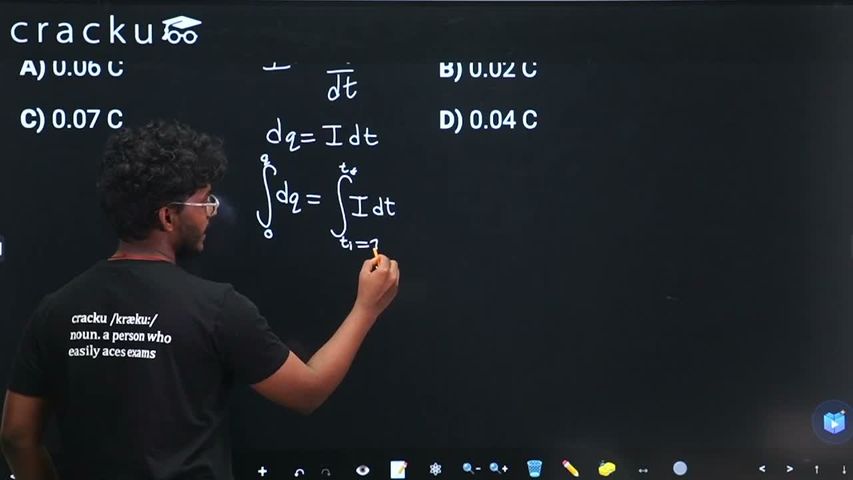
Click on the Email ☝️ to Watch the Video Solution
Create a FREE account and get:
_1.webp)

Educational materials for JEE preparation

Ask our AI anything

AI can make mistakes. Please verify important information.
AI can make mistakes. Please verify important information.
