
Join Our JEE Preparation Group
Prep with like-minded aspirants; Get access to free daily tests and study material.
Sign in
Please select an account to continue using cracku.in
↓ →
Join Our JEE Preparation Group
Prep with like-minded aspirants; Get access to free daily tests and study material.
Given below are two statements:
Assertion A: The kinetic energy needed to project a body of mass m from earth surface to infinity is $$\dfrac{1}{2}mgR$$, where R is the radius of earth.
Reason R: The maximum potential energy of a body is zero when it is projected to infinity from earth surface.
In the light of the above statements, choose the correct answer from the option given below
For a body of mass $$m$$ projected from the earth’s surface (radius $$R$$) let the minimum speed required to reach infinity with zero speed be $$v_e$$ (escape velocity).
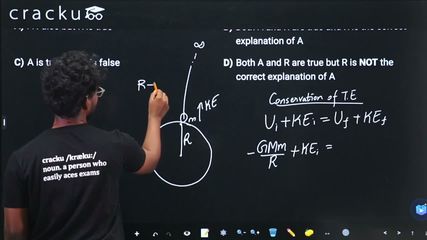
Gravitational potential energy at the earth’s surface is $$U_s = -\dfrac{GMm}{R}$$, while at infinity it is $$U_\infty = 0$$ (this is the highest possible value of gravitational potential energy).
Using conservation of mechanical energy, the total energy at the surface must equal the total energy at infinity:
$$\dfrac{1}{2} m v_e^2 + \left(-\dfrac{GMm}{R}\right) = 0 \quad -(1)$$
Solving $$(1)$$ gives the escape velocity:
$$v_e = \sqrt{\dfrac{2GM}{R}}$$
The kinetic energy that must be supplied is therefore
$$K = \dfrac{1}{2} m v_e^2 = \dfrac{1}{2} m \left(\dfrac{2GM}{R}\right) = \dfrac{GMm}{R}$$
Using $$g = \dfrac{GM}{R^2}$$, we rewrite this as
$$K = m g R$$
Assertion A claims the required kinetic energy is $$\dfrac{1}{2} m g R$$, which is not equal to the correct value $$m g R$$. Hence Assertion A is false.
Reason R states that “the maximum potential energy of a body is zero when it is projected to infinity from the earth’s surface.”
Because gravitational potential is defined to be zero at infinity and is negative everywhere else, this statement is true.
Therefore, A is false but R is true. The correct option is Option A.
Was this solution helpful?
Click on the Email ☝️ to Watch the Video Solution
Create a FREE account and get:
_1.webp)

Educational materials for JEE preparation

Ask our AI anything

AI can make mistakes. Please verify important information.
AI can make mistakes. Please verify important information.
