
Join Our JEE Preparation Group
Prep with like-minded aspirants; Get access to free daily tests and study material.
Sign in
Please select an account to continue using cracku.in
↓ →
Join Our JEE Preparation Group
Prep with like-minded aspirants; Get access to free daily tests and study material.
The rate of a certain biochemical reaction at physiological temperature (T) occurs $$10^6$$ times faster with enzyme than without. The change in the activation energy upon adding enzyme is:
For any reaction, the Arrhenius equation relates the rate constant $$k$$ to the activation energy $$E_a$$ as
$$k = A\,e^{-E_a/RT}$$
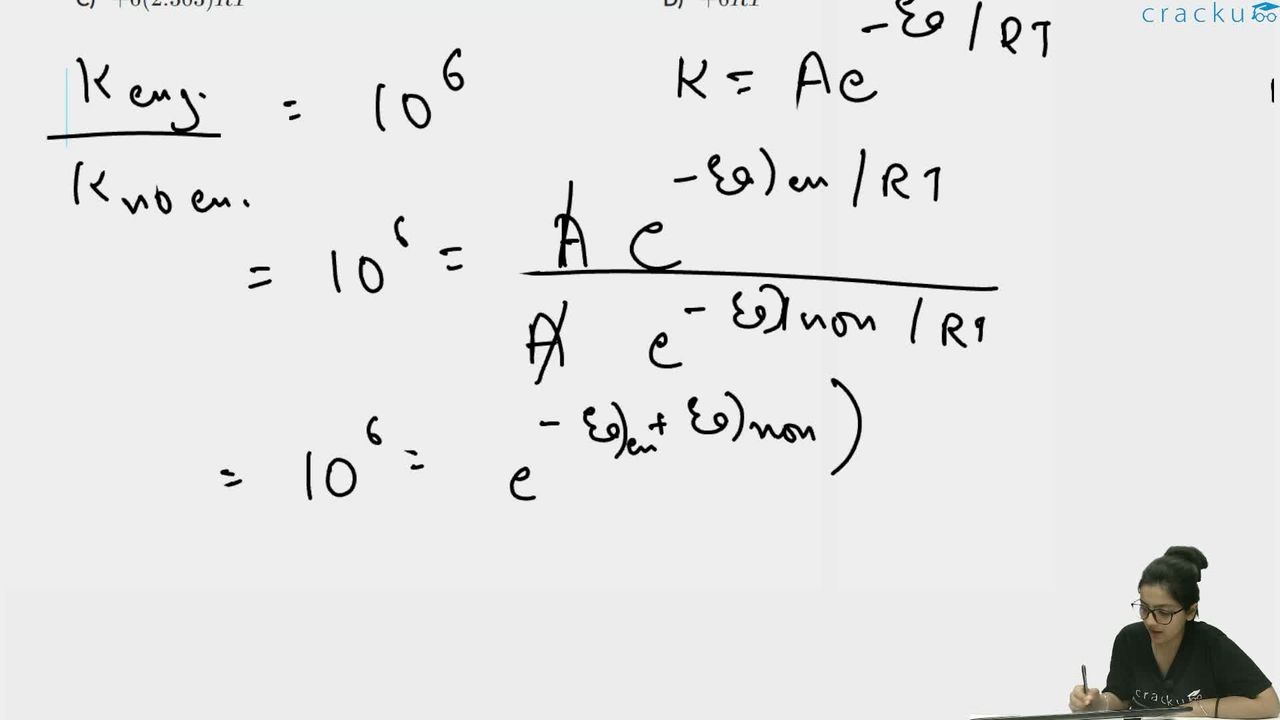
where $$A$$ is the pre-exponential factor, $$R$$ is the gas constant, and $$T$$ is the absolute temperature. We are told that in the presence of the enzyme the reaction is $$10^6$$ times faster, that is
$$\dfrac{k_{\text{enzyme}}}{k_{\text{no enzyme}}}=10^6.$$
Using the Arrhenius form for each rate constant, we have
$$\dfrac{A\,e^{-E_{a,\text{enzyme}}/RT}}{A\,e^{-E_{a,\text{no enzyme}}/RT}} = 10^6.$$
The pre-exponential factor $$A$$ cancels, giving
$$e^{-\dfrac{E_{a,\text{enzyme}}}{RT}} \, e^{+\dfrac{E_{a,\text{no enzyme}}}{RT}} = 10^6.$$
Combining the exponents,
$$e^{-\dfrac{E_{a,\text{enzyme}} - E_{a,\text{no enzyme}}}{RT}} = 10^6.$$
Taking natural logarithms on both sides, we get
$$-\dfrac{E_{a,\text{enzyme}} - E_{a,\text{no enzyme}}}{RT} = \ln(10^6).$$
Now $$\ln(10^6) = 6\ln(10) = 6(2.303).$$ Substituting this value,
$$-\dfrac{E_{a,\text{enzyme}} - E_{a,\text{no enzyme}}}{RT} = 6(2.303).$$
Multiplying both sides by $$-RT$$ gives the change in activation energy:
$$E_{a,\text{enzyme}} - E_{a,\text{no enzyme}} = -6(2.303)RT.$$
Thus the activation energy decreases by $$6(2.303)RT$$ when the enzyme is added.
Hence, the correct answer is Option A.
Was this solution helpful?
Click on the Email ☝️ to Watch the Video Solution
Create a FREE account and get:
_1.webp)

Educational materials for JEE preparation

Ask our AI anything

AI can make mistakes. Please verify important information.
AI can make mistakes. Please verify important information.
