
Join Our JEE Preparation Group
Prep with like-minded aspirants; Get access to free daily tests and study material.
Sign in
Please select an account to continue using cracku.in
↓ →
Join Our JEE Preparation Group
Prep with like-minded aspirants; Get access to free daily tests and study material.
From a solid sphere of mass $$M$$ and radius $$R$$, a spherical portion of radius $$\left(\frac{R}{2}\right)$$ is removed as shown in the figure. Taking gravitational potential $$V = 0$$ at $$r = \infty$$, the potential at the centre of the cavity thus formed is ($$G$$ = gravitational constant)
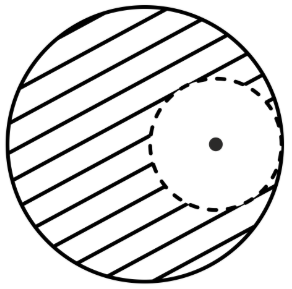
$$V_P = V_1 - V_2$$
The mass of the removed part is $$m = M\left(\frac{R/2}{R}\right)^3=\frac{M}{8}$$
Potential inside a uniform solid sphere at a distance $$x$$ from its centre is $$V(x)=-\frac{GM}{2R^3}(3R^2-x^2)$$
Substituting $$x=\frac{R}{2}$$,
$$V_1=-\frac{GM}{2R^3}\left[3R^2-\left(\frac{R}{2}\right)^2\right]$$
$$V_1=-\frac{GM}{2R^3}\left(3R^2-\frac{R^2}{4}\right)$$
$$V_1=-\frac{GM}{2R^3}\left(\frac{11R^2}{4}\right)=-\frac{11GM}{8R}$$
The potential at the centre of a uniform solid sphere of mass $$m$$ and radius $$r$$ is $$V_2=-\frac{3Gm}{2r}$$
For the removed sphere, $$m=\frac{M}{8},\qquad r=\frac{R}{2}$$
Therefore, $$V_2=-\frac{3G(M/8)}{2(R/2)}=-\frac{3GM}{8R}$$
Since the sphere is removed, $$V_P=V_1-V_2$$
$$V_P=\left(-\frac{11GM}{8R}\right)-\left(-\frac{3GM}{8R}\right)$$
$$V_P=-\frac{GM}{R}$$
Therefore, $${V_P=-\frac{GM}{R}}$$
Hence, the correct option is C.
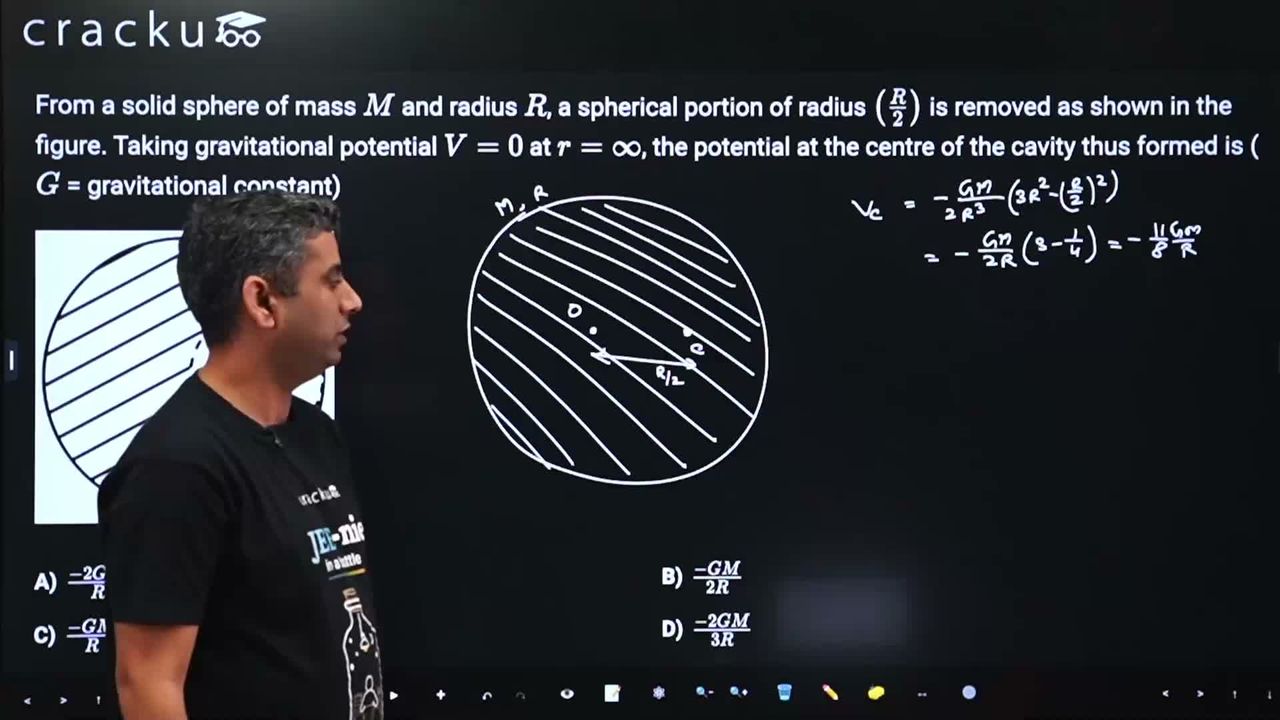
Click on the Email ☝️ to Watch the Video Solution
Create a FREE account and get:
_1.webp)

Educational materials for JEE preparation

Ask our AI anything

AI can make mistakes. Please verify important information.
AI can make mistakes. Please verify important information.


