
Join Our JEE Preparation Group
Prep with like-minded aspirants; Get access to free daily tests and study material.
Sign in
Please select an account to continue using cracku.in
↓ →
Join Our JEE Preparation Group
Prep with like-minded aspirants; Get access to free daily tests and study material.
Which one of the following options represents the magnetic field $$\vec{B}$$ at O due to the current flowing in the given wire segments lying on the $$xy$$ plane?
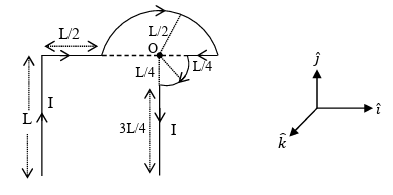
The magnetic field at any point is obtained by adding the contributions from each current-carrying segment separately.
For every straight segment lying in the $$xy$$-plane the field at the point O is perpendicular to the plane, i.e. along $$\pm \hat{k}$$. We therefore have to calculate only the magnitudes and check the sign with the right-hand rule.
Magnetic field of a straight wire.
For an infinitely long straight wire at a perpendicular distance $$d$$ from the observation point,
$$B=\dfrac{\mu_0 I}{2\pi d}$$.
Magnetic field of a finite straight wire.
For a straight piece of length $$AB$$ the field at a point P lying at a perpendicular distance $$r$$ from the wire is
$$B=\dfrac{\mu_0 I}{4\pi r}\left(\sin\theta_1+\sin\theta_2\right)$$ $$-(1)$$
where $$\theta_1$$ and $$\theta_2$$ are the angles made by the lines PA and PB with the perpendicular from P to the wire.
The geometry given in the figure consists of two parts: (i) an infinitely long wire whose closest distance from O is $$d=\dfrac{L}{2\pi}$$, and (ii) a straight segment of length $$L$$ lying parallel to the $$x$$-axis at a height $$y=L$$ above O, its right end being at $$(L,L)$$. Both carry the same current $$I$$.
(i) Field due to the infinitely long wire
Using the expression written above,
$$B_1=\dfrac{\mu_0 I}{2\pi d}=\dfrac{\mu_0 I}{2\pi\left(L/2\pi\right)}
=\dfrac{\mu_0 I}{L}.$$
With the current direction shown in the figure, the right-hand rule gives the direction as $$-\hat{k}$$.
(ii) Field due to the finite segment of length $$L$$
For this segment the perpendicular distance from O is $$r=L$$.
The nearer end of the segment lies directly above O, so $$\theta_1=0^{\circ}$$ and hence $$\sin\theta_1=0$$.
For the farther end at $$(L,L)$$, the line joining it to O makes an angle of $$45^{\circ}$$ with the perpendicular; therefore $$\sin\theta_2=\sin45^{\circ}=\dfrac{1}{\sqrt2}$$.
Substituting these values in $$(1)$$,
$$B_2=\dfrac{\mu_0 I}{4\pi L}\left(0+\dfrac{1}{\sqrt2}\right)
=\dfrac{\mu_0 I}{4\sqrt2\pi L}.$$
The same right-hand rule shows that this field is also along $$-\hat{k}$$.
Net magnetic field at O
Both contributions point along $$-\hat{k}$$, so the magnitudes simply add:
$$\vec{B}= -\hat{k}\left(\dfrac{\mu_0 I}{L}
+\dfrac{\mu_0 I}{4\sqrt2\pi L}\right)
=\dfrac{-\mu_0 I}{L}\left(1+\dfrac{1}{4\sqrt2\pi}\right)\hat{k}.$$
Comparing with the given options, this is exactly Option C.
Option C which is: $$\vec{B} = \dfrac{-\mu_0 I}{L}\left(1 + \dfrac{1}{4\sqrt{2}\pi}\right)\hat{k}.$$
Was this solution helpful?
Create a FREE account and get:
_1.webp)

Educational materials for JEE preparation

Ask our AI anything

AI can make mistakes. Please verify important information.
AI can make mistakes. Please verify important information.
