
Join Our JEE Preparation Group
Prep with like-minded aspirants; Get access to free daily tests and study material.
Sign in
Please select an account to continue using cracku.in
↓ →
Join Our JEE Preparation Group
Prep with like-minded aspirants; Get access to free daily tests and study material.
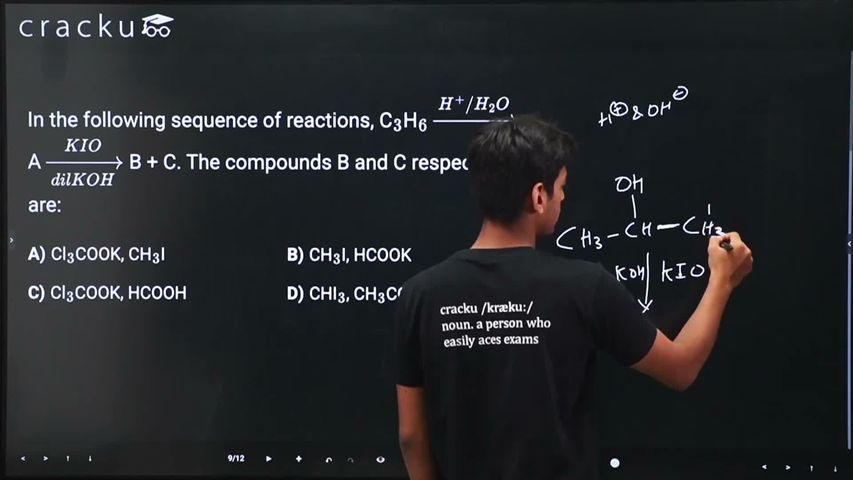
In the following sequence of reactions, C$$_3$$H$$_6$$ $$\xrightarrow{H^+/H_2O}$$ A $$\xrightarrow[dil KOH]{KIO}$$ B + C. The compounds B and C respectively are:
We have the molecular formula $$\mathrm{C_3H_6}$$. In open-chain form, the only alkene possible is propene, written structurally as $$\mathrm{CH_3-CH=CH_2}$$.
The first reagent is aqueous acid, written as $$\mathrm{H^+/H_2O}$$. In the presence of dilute acid, an alkene undergoes electrophilic addition of water. The governing principle is Markovnikov’s rule: “When HX or H-OH adds to an unsymmetrical alkene, the hydrogen attaches to the doubly-bonded carbon already holding the larger number of hydrogens, and the other part (here -OH) goes to the other carbon.” Applying that rule to propene, the -OH group attaches to the middle carbon while the extra hydrogen attaches to the terminal carbon.
Writing every step symbolically,
$$$\mathrm{CH_3-CH=CH_2 \;+\; H^+ \xrightarrow{\;\;}\; CH_3-CH^+-CH_3}$$$ $$$\mathrm{CH_3-CH^+-CH_3 \;+\; H_2O \longrightarrow CH_3-CH(OH)-CH_3 + H^+}$$$
Thus the product after the first step is $$\mathrm{CH_3-CH(OH)-CH_3}$$, i.e. propan-2-ol (commonly called isopropyl alcohol). Let us designate it as compound $$A$$.
Now $$A$$ is treated with “$$\mathrm{KIO/dil\;KOH}$$”. In the laboratory the iodoform reaction is normally carried out with iodine and alkali ($$\mathrm{I_2/KOH}$$); $$\mathrm{I_2}$$ in base actually produces the active species hypoiodite $$\mathrm{IO^-}$$, so writing the reagent as $$\mathrm{KIO}$$ in dilute $$\mathrm{KOH}$$ conveys the same chemistry. The iodoform reaction occurs whenever the substrate contains either
(i) a methyl ketone group $$\mathrm{ -CO-CH_3}$$, or
(ii) an alcohol that can be oxidised in situ to such a ketone, specifically $$\mathrm{R-CH(OH)-CH_3}$$.
Propan-2-ol fits criterion (ii) because it has the fragment $$\mathrm{ -CH(OH)-CH_3}$$. The reaction sequence is:
1. Oxidation of the secondary alcohol to the corresponding methyl ketone (propan-2-one, acetone).
$$$\mathrm{CH_3-CH(OH)-CH_3 + [O] \longrightarrow CH_3-CO-CH_3 + H_2O}$$$
2. Successive iodination of the $$\mathrm{ -CO-CH_3}$$ group and base-promoted cleavage, giving yellow iodoform and a carboxylate anion whose carbon skeleton is the original ketone minus the iodine-bearing methyl group.
For acetone the detailed stoichiometry can be summarised as
$$$\mathrm{CH_3-CO-CH_3 + 3\,I_2 + 4\,KOH \longrightarrow CHI_3 \downarrow + CH_3COOK + 3\,KI + 3\,H_2O}$$$
Therefore the two organic products obtained from the iodoform reaction of propan-2-ol are
$$$\mathrm{CHI_3} \quad\text{(iodoform, a yellow solid)}$$$
and
$$$\mathrm{CH_3COOK} \quad\text{(potassium acetate)}$$$
Denoting them in the order given in the problem statement, we can identify
$$B = \mathrm{CHI_3}, \qquad C = \mathrm{CH_3COOK}$$
Among the alternatives, only Option D lists the pair “$$\mathrm{CHI_3}$$, $$\mathrm{CH_3COOK}$$”.
Hence, the correct answer is Option D.
Was this solution helpful?
Click on the Email ☝️ to Watch the Video Solution
Create a FREE account and get:
_1.webp)

Educational materials for JEE preparation

Ask our AI anything

AI can make mistakes. Please verify important information.
AI can make mistakes. Please verify important information.
