
Join Our JEE Preparation Group
Prep with like-minded aspirants; Get access to free daily tests and study material.
Sign in
Please select an account to continue using cracku.in
↓ →
Join Our JEE Preparation Group
Prep with like-minded aspirants; Get access to free daily tests and study material.
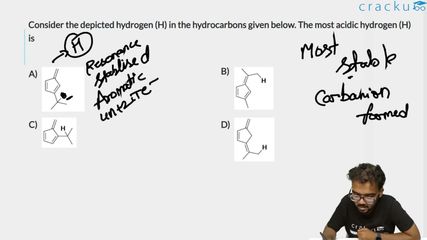
Consider the depicted hydrogen (H) in the hydrocarbons given below. The most acidic hydrogen (H) is
In Option A, the highlighted hydrogen is attached to an $$sp^3$$ hybridized carbon located directly on the ring.
Because aromaticity provides an immense amount of thermodynamic stability, the conjugate base is exceptionally stable. This makes the starting proton in Option A highly acidic
Option B: The hydrogen is on an exocyclic methyl group. If you remove this proton, the negative charge is allylic and can delocalize, but it cannot convert the cyclopentadiene ring into a fully aromatic system.
Option C: The hydrogen is on an external isopropyl-like group. Deprotonation here leaves the negative charge isolated from the ring system entirely, resulting in a highly unstable, localized $$sp^3$$ carbanion.
Option D: The hydrogen is at the bottom of the ring, but on a carbon that is already $$sp^2$$ hybridized (part of a double bond). Removing a proton from an $$sp^2$$ vinyl position is extremely unfavorable because the negative charge is held in an $$sp^2$$ orbital perpendicular to the $$\pi$$-system, meaning it receives zero resonance stabilization.
Correct Option: A
Was this solution helpful?
Click on the Email ☝️ to Watch the Video Solution
Create a FREE account and get:
_1.webp)

Educational materials for JEE preparation

Ask our AI anything

AI can make mistakes. Please verify important information.
AI can make mistakes. Please verify important information.
