Join Our JEE Preparation Group
Prep with like-minded aspirants; Get access to free daily tests and study material.
Sign in
Please select an account to continue using cracku.in
↓ →
Join Our JEE Preparation Group
Prep with like-minded aspirants; Get access to free daily tests and study material.
According to NCERT Class 11 Chemistry, Chapter 8: Organic Chemistry - Some Basic Principles and Techniques, when there is a choice in numbering, the double bond gets preference over the triple bond for the lower locant. Additionally, the E/Z system of nomenclature is based on the Cahn-Ingold-Prelog (CIP) priority rules.
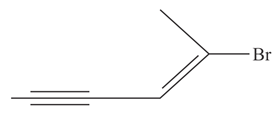
To name this compound, we first identify the longest continuous carbon chain containing both the double and triple bonds. This chain consists of six carbons, making the parent alkane hexane. When numbering the chain to give the multiple bonds the lowest possible locants, numbering from right to left assigns the double bond to carbon-2 and the triple bond to carbon-4. If we numbered from left to right, the triple bond would be at carbon-2 and the double bond at carbon-4. Because IUPAC rules dictate that a double bond receives priority for the lower number when they are equidistant from the ends, the right-to-left numbering is correct. This places the bromine substituent on carbon-2.
Next, we determine the stereochemistry of the double bond using the CIP priority rules by evaluating the atoms attached to carbon-2 and carbon-3. At carbon-2, the attached bromine atom has a higher atomic number than the carbon of the methyl group, giving bromine the higher priority. At carbon-3, the carbon of the alkyne group has priority over the implied hydrogen atom. Looking at the molecule's geometry, the high-priority bromine atom and the high-priority carbon chain are on opposite sides of the double bond axis. Because these groups are on opposite sides, the double bond is assigned an "E" configuration. Combining the stereochemistry, the substituent, and the parent chain with its multiple bonds gives the final name of (2E)-2-bromohex-2-en-4-yne.
Was this solution helpful?
Create a FREE account and get:
_1.webp)

Educational materials for JEE preparation

Ask our AI anything

AI can make mistakes. Please verify important information.
AI can make mistakes. Please verify important information.