
Join Our JEE Preparation Group
Prep with like-minded aspirants; Get access to free daily tests and study material.
Sign in
Please select an account to continue using cracku.in
↓ →
Join Our JEE Preparation Group
Prep with like-minded aspirants; Get access to free daily tests and study material.
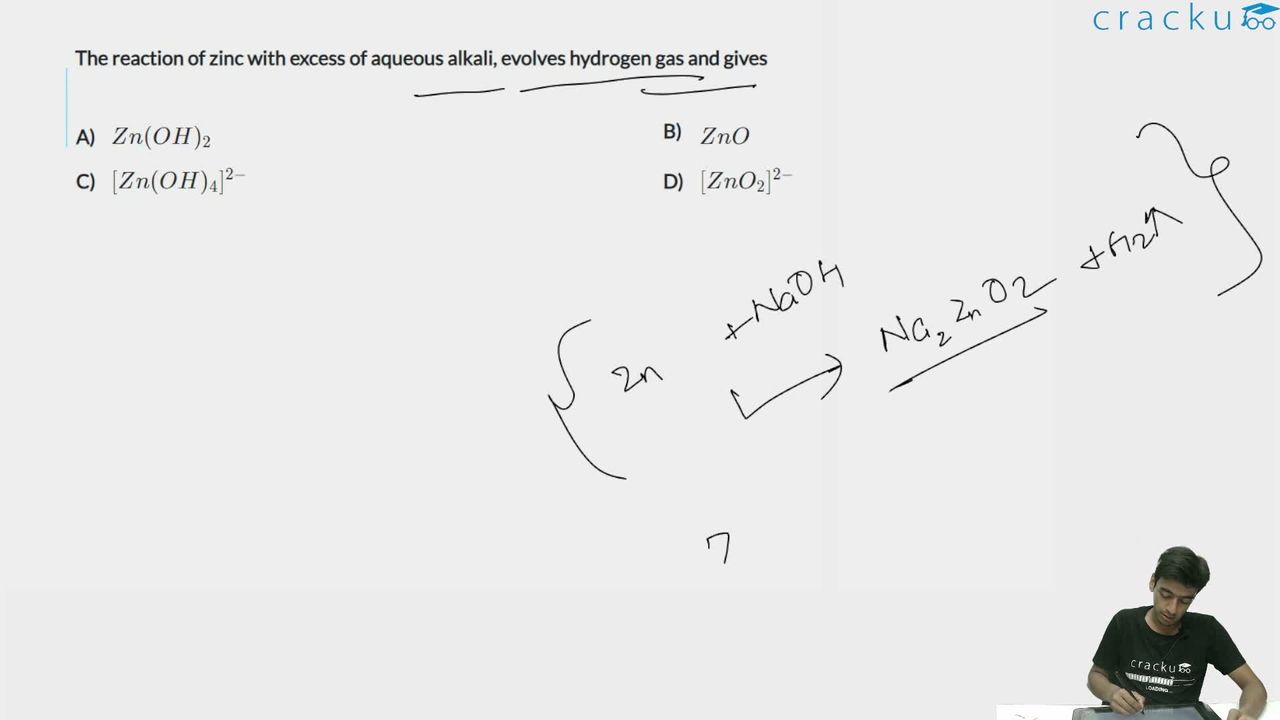
We are given the reaction of zinc with excess aqueous alkali. Zinc is an amphoteric metal, meaning it can react with both acids and bases.
When zinc reacts with excess aqueous NaOH (alkali), the reaction proceeds as:
$$Zn + 2NaOH \rightarrow Na_2ZnO_2 + H_2 \uparrow$$
Here, zinc dissolves in the excess alkali solution and reduces water to liberate hydrogen gas. The sodium zincate $$Na_2ZnO_2$$ formed dissociates in solution to give the zincate ion $$[ZnO_2]^{2-}$$.
Now, one might wonder why the product is $$[ZnO_2]^{2-}$$ rather than $$Zn(OH)_2$$ or $$[Zn(OH)_4]^{2-}$$. When the alkali is in excess, any $$Zn(OH)_2$$ initially formed further reacts with NaOH:
$$Zn(OH)_2 + 2NaOH \rightarrow Na_2ZnO_2 + 2H_2O$$
This converts the hydroxide completely into the zincate ion $$[ZnO_2]^{2-}$$. The species $$ZnO$$ and $$Zn(OH)_2$$ are only intermediate products and do not persist when alkali is in excess.
Hence, the correct answer is Option D: $$[ZnO_2]^{2-}$$.
Was this solution helpful?
Click on the Email ☝️ to Watch the Video Solution
Create a FREE account and get:
_1.webp)

Educational materials for JEE preparation

Ask our AI anything

AI can make mistakes. Please verify important information.
AI can make mistakes. Please verify important information.
