
Join Our JEE Preparation Group
Prep with like-minded aspirants; Get access to free daily tests and study material.
Sign in
Please select an account to continue using cracku.in
↓ →
Join Our JEE Preparation Group
Prep with like-minded aspirants; Get access to free daily tests and study material.
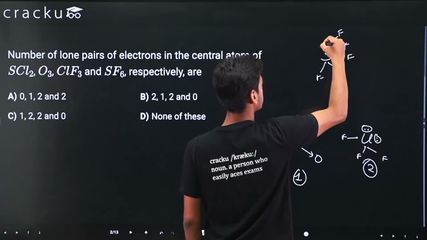
Number of lone pairs of electrons in the central atom of $$SCl_2$$, $$O_3$$, $$ClF_3$$ and $$SF_6$$, respectively, are
We need to find the number of lone pairs on the central atom in each of $$SCl_2$$, $$O_3$$, $$ClF_3$$, and $$SF_6$$.
$$SCl_2$$: Sulfur is the central atom with 6 valence electrons. It forms 2 bonds with Cl atoms, using 2 electrons. The remaining 4 electrons form 2 lone pairs. So the central atom has 2 lone pairs.
$$O_3$$: The central oxygen atom has 6 valence electrons. In ozone, the central oxygen forms a double bond with one oxygen and a single bond (plus coordinate bond character) with the other. Using the Lewis structure, the central oxygen has 2 bonding domains and 1 lone pair. So the central atom has 1 lone pair.
$$ClF_3$$: Chlorine is the central atom with 7 valence electrons. It forms 3 bonds with F atoms, using 3 electrons. The remaining 4 electrons form 2 lone pairs. The shape is T-shaped (from a trigonal bipyramidal arrangement with 2 lone pairs in equatorial positions). So the central atom has 2 lone pairs.
$$SF_6$$: Sulfur is the central atom with 6 valence electrons. It forms 6 bonds with F atoms, using all 6 valence electrons (and expanding the octet). There are 0 lone pairs on sulfur.
The lone pairs are therefore 2, 1, 2, and 0 respectively.
Hence, the correct answer is Option B.
Was this solution helpful?
Click on the Email ☝️ to Watch the Video Solution
Create a FREE account and get:
_1.webp)

Educational materials for JEE preparation

Ask our AI anything

AI can make mistakes. Please verify important information.
AI can make mistakes. Please verify important information.
