
Join Our JEE Preparation Group
Prep with like-minded aspirants; Get access to free daily tests and study material.
Sign in
Please select an account to continue using cracku.in
↓ →
Join Our JEE Preparation Group
Prep with like-minded aspirants; Get access to free daily tests and study material.
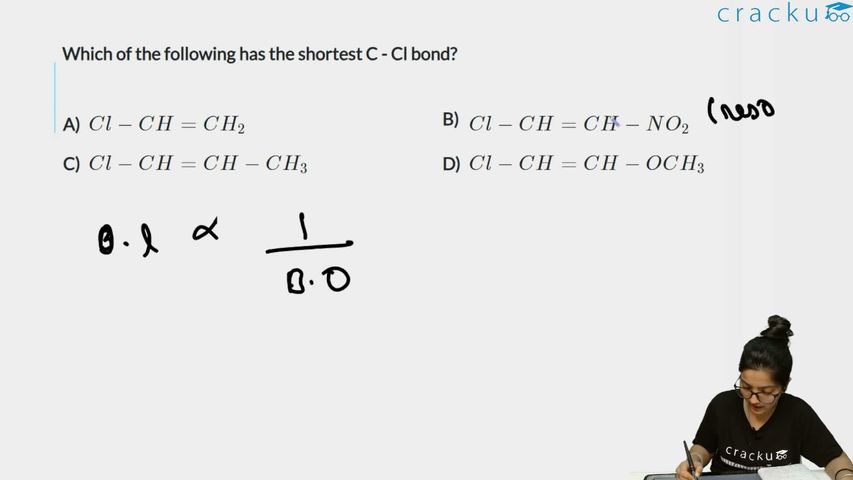
First, let us recall a general fact from chemical bonding: $$\text{Bond length} \propto \dfrac1{\text{Bond order}}.$$
So, if any factor increases the bond order of the $$\text{C-Cl}$$ bond (that is, gives it some double-bond character), the bond will become shorter. Conversely, anything that decreases the bond order will make the bond longer.
In vinyl chlorides the lone pair on chlorine can take part in resonance with the adjacent $$\mathrm C=C$$ double bond. We write the two principal resonance structures as
$$$Cl{-}CH=CH\!-\!R \;\longleftrightarrow\; Cl^{+}=CH{-}CH^{-}\!-\!R$$$
where $$R$$ stands for the group attached to the second carbon ($$CH_2,\ NO_2,\ CH_3,\ OCH_3$$ in the four alternatives). In the right-hand structure the $$\text{C-Cl}$$ bond is a double bond ($$Cl^{+}=C$$), so a greater contribution of this structure means a higher bond order and a shorter bond.
Now we must analyse how the substituent $$R$$ affects the contribution of this resonance form.
• If $$R$$ is an electron-withdrawing group (strong −I / −M effect), it pulls electron density away from the $$\pi$$-system. The negative charge on the second carbon in the resonance form $$Cl^{+}=CH{-}CH^{-}\!-\!R$$ is then stabilised because the group can accommodate or disperse that negative charge. This stabilisation increases the importance of the double-bond structure, raises the bond order of $$\text{C-Cl}$$, and consequently shortens the bond.
• If $$R$$ is an electron-donating group (+I or +M), it pushes electrons toward the double bond. That makes the negatively charged resonance form less favourable, decreases the double-bond character between C and Cl, lowers the bond order, and lengthens the bond.
Let us classify each substituent provided:
$$$\begin{aligned} R &= CH_2 \quad &(\text{no strong effect}) \\ R &= NO_2 \quad &(\text{strong } -I \text{ and } -M,\ \text{very electron-withdrawing}) \\ R &= CH_3 \quad &(\text{weak } +I,\ \text{slightly electron-releasing}) \\ R &= OCH_3 \quad &(\text{strong } +M,\ \text{electron-donating by resonance}) \end{aligned}$$$
Among these, $$NO_2$$ is by far the strongest electron-withdrawing group. Therefore the resonance form containing $$Cl^{+}=C$$ is most stabilised when $$R = NO_2$$, giving the $$\text{C-Cl}$$ bond its greatest double-bond character and the least length.
Writing this conclusion explicitly:
$$$\text{Bond order of C-Cl: } NO_2 > CH_2 \approx CH_3 > OCH_3$$$
Hence, the $$\text{C-Cl}$$ bond is shortest in $$Cl{-}CH=CH{-}NO_2$$, which corresponds to Option B.
Hence, the correct answer is Option 2.
Was this solution helpful?
Click on the Email ☝️ to Watch the Video Solution
Create a FREE account and get:
_1.webp)

Educational materials for JEE preparation

Ask our AI anything

AI can make mistakes. Please verify important information.
AI can make mistakes. Please verify important information.
