
Join Our JEE Preparation Group
Prep with like-minded aspirants; Get access to free daily tests and study material.
Sign in
Please select an account to continue using cracku.in
↓ →
Join Our JEE Preparation Group
Prep with like-minded aspirants; Get access to free daily tests and study material.
List I describes four systems, each with two particles $$A$$ and $$B$$ in relative motion as shown in figure. List II gives possible magnitudes of their relative velocities (in ms$$^{-1}$$) at time $$t = \frac{\pi}{3}$$ s.
| List-I | List-II |
|---|---|
(I) $$A$$ and $$B$$ are moving on a horizontal circle of radius 1 m with uniform angular speed $$\omega = 1$$ rad s$$^{-1}$$. The initial angular positions of $$A$$ and $$B$$ at time $$t = 0$$ are $$\theta = 0$$ and $$\theta = \frac{\pi}{2}$$ respectively.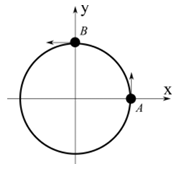 | (P) $$\frac{\sqrt{3}+1}{2}$$ |
(II) Projectiles $$A$$ and $$B$$ are fired (in the same vertical plane) at $$t = 0$$ and $$t = 0.1$$ s respectively, with the same speed $$v = \frac{5\pi}{\sqrt{2}}$$ m s$$^{-1}$$ and at $$45^\circ$$ from the horizontal plane. The initial separation between $$A$$ and $$B$$ is large enough so that they do not collide. ($$g = 10$$ m s$$^{-2}$$).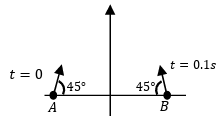 | (Q) $$\frac{\sqrt{3}-1}{\sqrt{2}}$$ |
(III) Two harmonic oscillators $$A$$ and $$B$$ moving in the $$x$$ direction according to $$x_A = x_0 \sin \frac{t}{t_0}$$ and $$x_B = x_0 \sin\left(\frac{t}{t_0} + \frac{\pi}{2}\right)$$ respectively, starting from $$t = 0$$. Take $$x_0 = 1$$ m, $$t_0 = 1$$ s.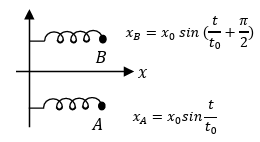 | (R) $$\sqrt{10}$$ |
(IV) Particle $$A$$ is rotating in a horizontal circular path of radius 1 m on the $$xy$$ plane, with constant angular speed $$\omega = 1$$ rad s$$^{-1}$$. Particle $$B$$ is moving up at a constant speed 3 m s$$^{-1}$$ in the vertical direction as shown in the figure. (Ignore gravity.)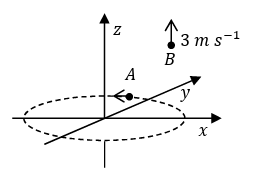 | (S) $$\sqrt{2}$$ |
| (T) $$\sqrt{25\pi^2 + 1}$$ |
Which one of the following options is correct?
Case I (List-I I)
The two particles move on the same horizontal circle of radius $$r = 1\ \text{m}$$ with the same angular speed $$\omega = 1\ \text{rad s}^{-1}$$.
At any instant their linear speeds are identical: $$v_A = v_B = r\omega = 1\ \text{m s}^{-1}$$.
Their angular positions differ by $$\frac{\pi}{2}$$ at all times, so the angle between the two velocity vectors is also $$\frac{\pi}{2}$$.
For two vectors of equal magnitude $$v$$ with an angle $$\phi$$ between them, the magnitude of the relative velocity is
$$v_{AB} = 2v\sin\frac{\phi}{2}$$.
Putting $$v = 1\ \text{m s}^{-1}$$ and $$\phi = \frac{\pi}{2}$$,
$$v_{AB} = 2(1)\sin\frac{\pi}{4} = 2\left(\frac{\sqrt{2}}{2}\right) = \sqrt{2}\ \text{m s}^{-1}$$.
Thus I → S.
Case II (List-I II)
Projectile A is fired at $$t = 0$$, and projectile B at $$t = 0.1\ \text{s}$$. Both have initial speed
$$v = \frac{5\pi}{\sqrt{2}}\ \text{m s}^{-1}$$ at an angle $$45^{\circ}$$ to the horizontal, but they move in opposite horizontal directions (shown in the figure).
Horizontal component of each velocity (magnitude) is
$$v_x = v\cos45^{\circ} = \frac{5\pi}{2}\ \text{m s}^{-1}$$,
so A moves with $$+v_x$$ and B with $$-v_x$$ along the $$x$$-axis.
At the required instant $$t = \dfrac{\pi}{3}\ \text{s}$$:
Time of flight for A: $$t_A = \dfrac{\pi}{3}$$.
Vertical velocity of A:
$$v_{yA} = v\sin45^{\circ} - gt_A = \frac{5\pi}{2} - 10\left(\frac{\pi}{3}\right) = -\frac{5\pi}{6}\ \text{m s}^{-1}$$.
Time of flight for B: $$t_B = \dfrac{\pi}{3} - 0.1$$.
Vertical velocity of B:
$$$
\begin{aligned}
v_{yB} &= v\sin45^{\circ} - gt_B \\
&= \frac{5\pi}{2} - 10\left(\frac{\pi}{3} - 0.1\right) \\
&= -\frac{5\pi}{6} + 1\ \text{m s}^{-1}.
\end{aligned}
$$$
Hence the components of the relative velocity $$\mathbf{v}_{AB} = \mathbf{v}_A - \mathbf{v}_B$$ are
$$v_{x\,AB} = +\frac{5\pi}{2} - \left(-\frac{5\pi}{2}\right) = 5\pi,$$
$$v_{y\,AB} = -\frac{5\pi}{6} - \left(-\frac{5\pi}{6} + 1\right) = -1.$$
Magnitude:
$$\left|\mathbf{v}_{AB}\right| = \sqrt{(5\pi)^2 + 1^2} = \sqrt{25\pi^2 + 1}\ \text{m s}^{-1}.$$
Thus II → T.
Case III (List-I III)
The displacements are $$x_A = \sin t$$ and $$x_B = \sin\left(t + \frac{\pi}{2}\right)$$ (with $$x_0 = t_0 = 1$$).
Velocities:
$$v_A = \frac{dx_A}{dt} = \cos t,$$
$$v_B = \frac{dx_B}{dt} = \cos\left(t + \frac{\pi}{2}\right) = -\sin t.$$
At $$t = \dfrac{\pi}{3}$$:
$$v_A = \cos\frac{\pi}{3} = \frac{1}{2},\qquad
v_B = -\sin\frac{\pi}{3} = -\frac{\sqrt{3}}{2}.$$
Relative velocity:
$$v_{AB} = v_A - v_B = \frac{1}{2} - \left(-\frac{\sqrt{3}}{2}\right)
= \frac{1 + \sqrt{3}}{2}\ \text{m s}^{-1}.$$
Thus III → P.
Case IV (List-I IV)
Particle A moves in the horizontal $$xy$$-plane on a circle of radius 1 m with angular speed $$\omega = 1\ \text{rad s}^{-1}$$, so
$$v_A = r\omega = 1\ \text{m s}^{-1}$$ (purely horizontal, tangent to the circle).
Particle B moves vertically upward with constant speed $$v_B = 3\ \text{m s}^{-1}$$ along the $$z$$-axis.
Since the two velocity vectors are mutually perpendicular, the magnitude of the relative velocity is
$$\left|\mathbf{v}_{AB}\right| = \sqrt{v_A^2 + v_B^2}
= \sqrt{1^2 + 3^2}
= \sqrt{10}\ \text{m s}^{-1}.$$
Thus IV → R.
Collecting all four mappings:
I → S, II → T, III → P, IV → R.
The option that matches this set is
Option C: I → S, II → T, III → P, IV → R.
Was this solution helpful?
Create a FREE account and get:
_1.webp)

Educational materials for JEE preparation

Ask our AI anything

AI can make mistakes. Please verify important information.
AI can make mistakes. Please verify important information.
