
Join Our JEE Preparation Group
Prep with like-minded aspirants; Get access to free daily tests and study material.
Sign in
Please select an account to continue using cracku.in
↓ →
Join Our JEE Preparation Group
Prep with like-minded aspirants; Get access to free daily tests and study material.
A small circular loop of area $$A$$ and resistance $$R$$ is fixed on a horizontal $$xy$$-plane with the center of the loop always on the axis $$\hat{n}$$ of a long solenoid. The solenoid has $$m$$ turns per unit length and carries current $$I$$ counterclockwise as shown in the figure. The magnetic field due to the solenoid is in $$\hat{n}$$ direction. List-I gives time dependences of $$\hat{n}$$ in terms of a constant angular frequency $$\omega$$.
List-II gives the torques experienced by the circular loop at time $$t = \frac{\pi}{6\omega}$$. Let $$\alpha = \frac{A^2 \mu_0^2 m^2 I^2 \omega}{2R}$$.
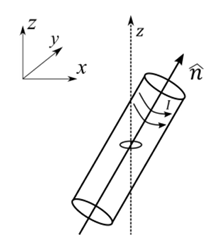
| List-I | List-II |
|---|---|
| (I) $$\frac{1}{\sqrt{2}}(\sin \omega t \, \hat{j} + \cos \omega t \, \hat{k})$$ | (P) 0 |
| (II) $$\frac{1}{\sqrt{2}}(\sin \omega t \, \hat{i} + \cos \omega t \, \hat{j})$$ | (Q) $$-\frac{\alpha}{4}\hat{i}$$ |
| (III) $$\frac{1}{\sqrt{2}}(\sin \omega t \, \hat{i} + \cos \omega t \, \hat{k})$$ | (R) $$\frac{3\alpha}{4}\hat{i}$$ |
| (IV) $$\frac{1}{\sqrt{2}}(\cos \omega t \, \hat{i} + \sin \omega t \, \hat{k})$$ | (S) $$\frac{\alpha}{4}\hat{j}$$ |
| Which one of the following options is correct? | (T) $$-\frac{3\alpha}{4}\hat{i}$$ |
I. $$\phi = B A \hat{k} \cdot \hat{n}$$
$$\phi = \frac{BA}{\sqrt{2}} \cos(\omega t)$$
$$\varepsilon = \frac{BA\omega}{\sqrt{2}} \sin(\omega t)$$
$$i = \frac{BA\omega}{\sqrt{2}R} \sin(\omega t)$$
$$\vec{m} = iA\hat{k} = \frac{BA^2\omega}{\sqrt{2}R}\sin(\omega t)\hat{k}$$
$$\vec{\tau} = \vec{m} \times \vec{B} = \frac{B^2A^2\omega}{\sqrt{2}R}\sin(\omega t)(\hat{k} \times \hat{n})$$
$$= -\frac{B^2A^2\omega}{2R} \left[\hat{i}\right]\sin^2(\omega t)$$
$$\tau = -\frac{B^2A^2\omega}{2R} \left[\sin^2\left(\frac{\pi}{6}\right)\right] = -\frac{\alpha}{4}\hat{i}$$
(I) $$\rightarrow$$ Q.
II. $$\phi = 0$$
(II) $$\rightarrow$$ P.
III. $$\phi = \frac{BA}{\sqrt{2}} \cos(\omega t)$$
$$i = \frac{BA\omega}{\sqrt{2}R}\sin(\omega t)$$
$$\vec{m} = \frac{BA^2\omega}{\sqrt{2}R}\sin(\omega t)\hat{k}$$
$$\vec{\tau} = \vec{m} \times \vec{B} = \frac{B^2A^2\omega}{\sqrt{2} \cdot \sqrt{2} R}\sin\omega t\left(\hat{k} \times (\sin\omega t\hat{i} + \cos\omega t\hat{k})\right)$$
$$\tau = \frac{B^2A^2\omega\sin(\omega t)}{2R}\sin(\omega t)\hat{j}$$
$$= \frac{B^2A^2\omega}{2R}\sin^2(\omega t)\hat{j}$$
$$= \frac{\alpha}{4}\hat{j}$$
(III) $$\rightarrow$$ S.
IV. $$\phi = \frac{BA}{\sqrt{2}}\sin(\omega t)$$
$$i = -\frac{BA\omega}{\sqrt{2}R}\cos(\omega t)$$
$$\vec{m} = -\frac{BA^2\omega}{\sqrt{2}R}\cos\omega t(\hat{k})$$
$$\vec{\tau} = \vec{m} \times \vec{B} = -\frac{B^2A^2\omega}{2R}(\hat{k} \times \hat{i})\cos^2(\omega t)$$
$$\tau = +\frac{B^2A^2\omega}{2R}(\hat{i}) \cdot \cos^2\left(\frac{\pi}{6}\right)$$
$$= +\frac{3}{4}\alpha\hat{i}$$
(IV) $$\rightarrow$$ R.
Was this solution helpful?
Create a FREE account and get:
_1.webp)

Educational materials for JEE preparation

Ask our AI anything

AI can make mistakes. Please verify important information.
AI can make mistakes. Please verify important information.
