
Join Our JEE Preparation Group
Prep with like-minded aspirants; Get access to free daily tests and study material.
Sign in
Please select an account to continue using cracku.in
↓ →
Join Our JEE Preparation Group
Prep with like-minded aspirants; Get access to free daily tests and study material.
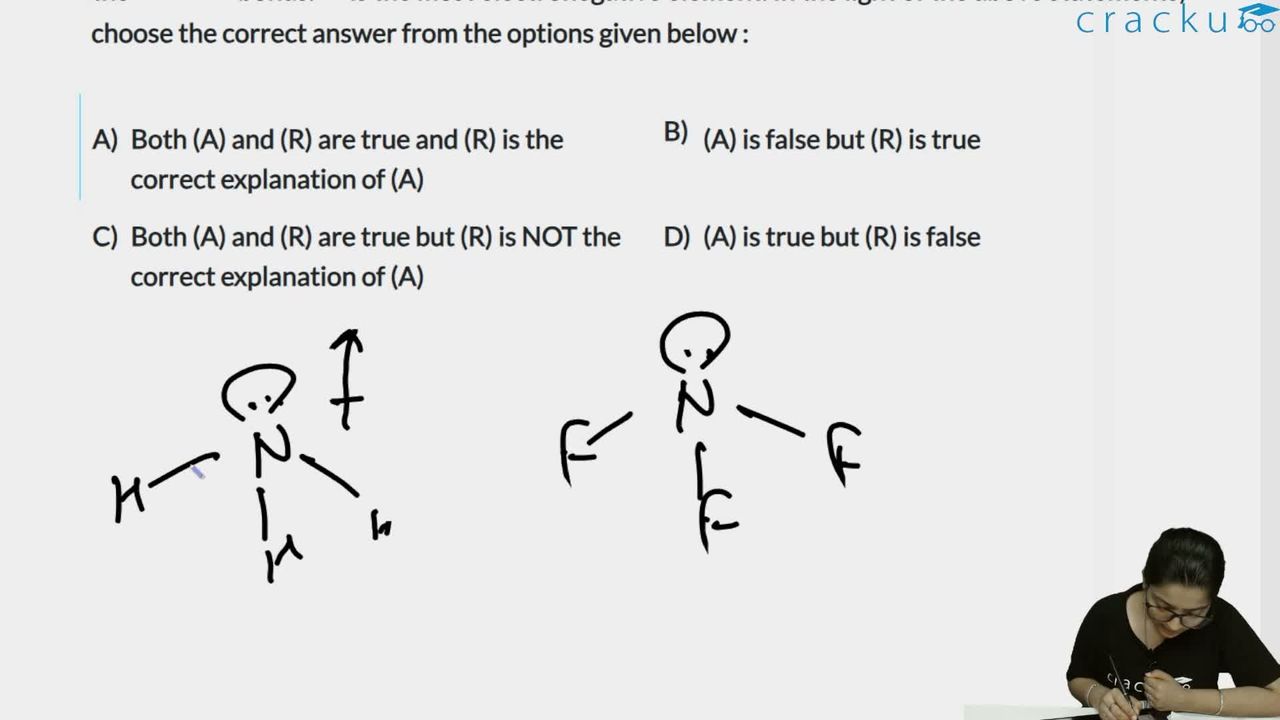
Given below are two statements : one is labelled as Assertion (A) and the other is labelled as Reason (R). Assertion (A) : $$NH_3$$ and $$NF_3$$ molecule have pyramidal shape with a lone pair of electrons on nitrogen atom. The resultant dipole moment of $$NH_3$$ is greater than that of $$NF_3$$. Reason (R) : In $$NH_3$$, the orbital dipole due to lone pair is in the same direction as the resultant dipole moment of the $$N-H$$ bonds. $$F$$ is the most electronegative element. In the light of the above statements, choose the correct answer from the options given below :
Assertion (A): $$NH_3$$ and $$NF_3$$ both have pyramidal shapes with a lone pair on nitrogen. The dipole moment of $$NH_3$$ is greater than that of $$NF_3$$.
Reason (R): In $$NH_3$$, the orbital dipole due to the lone pair is in the same direction as the resultant dipole moment of the N-H bonds. F is the most electronegative element.
Evaluate Assertion (A)
Both $$NH_3$$ ($$\mu = 1.47$$ D) and $$NF_3$$ ($$\mu = 0.23$$ D) are pyramidal. Indeed, $$\mu_{NH_3} > \mu_{NF_3}$$. Assertion A is true.
Evaluate Reason (R)
In $$NH_3$$: The bond dipoles of N-H point from H to N (since N is more electronegative). The lone pair on N also creates a dipole pointing away from N in the same direction. Both contributions add up, resulting in a large net dipole moment.
In $$NF_3$$: The bond dipoles of N-F point from N to F (since F is more electronegative), which is opposite to the direction of the lone pair dipole. The two effects partially cancel, resulting in a much smaller net dipole moment.
F is indeed the most electronegative element. Reason R is true and correctly explains why $$\mu_{NH_3} > \mu_{NF_3}$$.
Both (A) and (R) are true and (R) is the correct explanation of (A). The answer is Option 1.
Was this solution helpful?
Click on the Email ☝️ to Watch the Video Solution
Create a FREE account and get:
_1.webp)

Educational materials for JEE preparation

Ask our AI anything

AI can make mistakes. Please verify important information.
AI can make mistakes. Please verify important information.
