
Join Our JEE Preparation Group
Prep with like-minded aspirants; Get access to free daily tests and study material.
Sign in
Please select an account to continue using cracku.in
↓ →
Join Our JEE Preparation Group
Prep with like-minded aspirants; Get access to free daily tests and study material.
An evacuated glass vessel weighs $$40.0$$ g when empty, $$135.0$$ g when filled with a liquid of density $$0.95$$ g mL$$^{-1}$$ and $$40.5$$ g when filled with an ideal gas at $$0.82$$ atm at $$250$$ K. The molar mass of the gas in g mol$$^{-1}$$ is : (Given : $$R = 0.082$$ L atm K$$^{-1}$$ mol$$^{-1}$$)
An evacuated glass vessel weighs 40.0 g when empty, 135.0 g when filled with liquid (density 0.95 g/mL), and 40.5 g when filled with an ideal gas at 0.82 atm and 250 K. We need to find the molar mass of the gas.
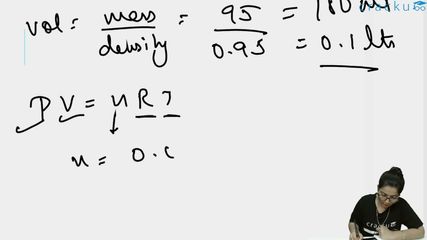
First, the mass of liquid introduced into the vessel is calculated as $$135.0 - 40.0 = 95.0$$ g. The volume of the vessel is then given by the ratio of this mass to the liquid’s density, namely $$\text{Volume} = \frac{\text{Mass}}{\text{Density}} = \frac{95.0}{0.95} = 100\text{ mL} = 0.1\text{ L}.$$
The mass of the gas is found from the difference between the filled and empty vessel masses, which yields $$40.5 - 40.0 = 0.5$$ g.
Since the gas behaves ideally, we apply the ideal gas law: $$PV = nRT.$$ Solving for the number of moles gives $$n = \frac{PV}{RT} = \frac{0.82 \times 0.1}{0.082 \times 250} = \frac{0.082}{20.5} = 0.004\text{ mol}.$$
The molar mass of the gas is then determined by dividing the mass by the number of moles: $$M = \frac{\text{mass}}{n} = \frac{0.5}{0.004} = 125\text{ g/mol}.$$
The correct answer is Option D: 125 g/mol.
Was this solution helpful?
Click on the Email ☝️ to Watch the Video Solution
Create a FREE account and get:
_1.webp)

Educational materials for JEE preparation

Ask our AI anything

AI can make mistakes. Please verify important information.
AI can make mistakes. Please verify important information.
