
Join Our JEE Preparation Group
Prep with like-minded aspirants; Get access to free daily tests and study material.
Sign in
Please select an account to continue using cracku.in
↓ →
Join Our JEE Preparation Group
Prep with like-minded aspirants; Get access to free daily tests and study material.
Two particles, 1 and 2, each of mass $$m$$, are connected by a massless spring, and are on a horizontal frictionless plane, as shown in the figure. Initially, the two particles, with their center of mass at $$x_0$$, are oscillating with amplitude $$a$$ and angular frequency $$\omega$$. Thus, their positions at time $$t$$ are given by $$x_1(t) = (x_0 + d) + a \sin \omega t$$ and $$x_2(t) = (x_0 - d) - a \sin \omega t$$, respectively, where $$d > 2a$$. Particle 3 of mass $$m$$ moves towards this system with speed $$u_0 = a\omega/2$$, and undergoes instantaneous elastic collision with particle 2, at time $$t_0$$. Finally, particles 1 and 2 acquire a center of mass speed $$v_{cm}$$ and oscillate with amplitude $$b$$ and the same angular frequency $$\omega$$.
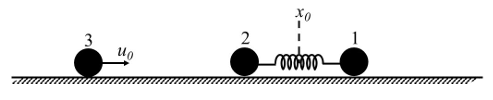
If the collision occurs at time $$t_0 = 0$$, the value of $$v_{cm}/(a\omega)$$ will be ________.
Correct Answer: 0.75
The positions of the two identical masses just before the collision are
$$x_1(t)=\bigl(x_0+d\bigr)+a\sin\omega t,\qquad x_2(t)=\bigl(x_0-d\bigr)-a\sin\omega t.$$
Differentiating, their velocities are
$$v_1(t)=a\omega\cos\omega t,\qquad v_2(t)=-a\omega\cos\omega t.$$
The collision takes place at $$t_0=0$$, so
$$v_{1i}=v_1(0)=a\omega,\qquad v_{2i}=v_2(0)=-a\omega.$$
Particle 3 (mass $$m$$) approaches from the left with speed
$$u_0=\tfrac{a\omega}{2}$$
towards the right (+ve $$x$$ direction). All three masses are equal, so a one-dimensional perfectly elastic collision simply makes the two colliding particles exchange their velocities.
Hence, immediately after the collision,
$$v_{3f}=-a\omega,\qquad v_{2f}=u_0=\tfrac{a\omega}{2},\qquad v_{1f}=v_{1i}=a\omega \;(\text{particle 1 is untouched}).$$
The centre-of-mass velocity of particles 1 and 2 after the collision is
$$v_{cm}=\frac{v_{1f}+v_{2f}}{2}=\frac{a\omega+\tfrac{a\omega}{2}}{2} =\frac{3a\omega/2}{2}= \frac{3}{4}\,a\omega.$$
Therefore,
$$\frac{v_{cm}}{a\omega}=\frac{3}{4}=0.75.$$
The required value is 0.75.
Was this solution helpful?
Create a FREE account and get:
_1.webp)

Educational materials for JEE preparation

Ask our AI anything

AI can make mistakes. Please verify important information.
AI can make mistakes. Please verify important information.
