
Join Our JEE Preparation Group
Prep with like-minded aspirants; Get access to free daily tests and study material.
Sign in
Please select an account to continue using cracku.in
↓ →
Join Our JEE Preparation Group
Prep with like-minded aspirants; Get access to free daily tests and study material.
Two particles, 1 and 2, each of mass $$m$$, are connected by a massless spring, and are on a horizontal frictionless plane, as shown in the figure. Initially, the two particles, with their center of mass at $$x_0$$, are oscillating with amplitude $$a$$ and angular frequency $$\omega$$. Thus, their positions at time $$t$$ are given by $$x_1(t) = (x_0 + d) + a \sin \omega t$$ and $$x_2(t) = (x_0 - d) - a \sin \omega t$$, respectively, where $$d > 2a$$. Particle 3 of mass $$m$$ moves towards this system with speed $$u_0 = a\omega/2$$, and undergoes instantaneous elastic collision with particle 2, at time $$t_0$$. Finally, particles 1 and 2 acquire a center of mass speed $$v_{cm}$$ and oscillate with amplitude $$b$$ and the same angular frequency $$\omega$$.
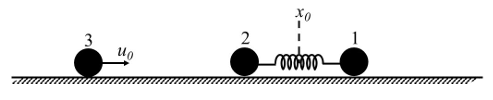
If the collision occurs at time $$t_0 = \pi/(2\omega)$$, then the value of $$4b^2/a^2$$ will be ________.
Correct Answer: 4.25
At any instant the coordinates of the two identical masses are given as
$$x_1(t)=\bigl(x_0+d\bigr)+a\sin\omega t,\qquad
x_2(t)=\bigl(x_0-d\bigr)-a\sin\omega t$$
Hence their centre-of-mass (C-O-M) position is
$$x_{cm}=\frac{x_1+x_2}{2}=x_0$$
which is fixed (initially the C-O-M is at rest).
For the system “two masses $$m$$ joined by a mass-less spring of force constant $$k$$” the oscillation (stretch-compress) mode has angular frequency
$$\omega=\sqrt{\frac{2k}{m}}\;.\qquad -(1)$$
At the instant of collision, $$t_0=\dfrac{\pi}{2\omega}\;,$$ we have
$$\sin\omega t_0 =\sin\frac{\pi}{2}=1,\qquad
\cos\omega t_0 =0.$$
Therefore, just before collision (denote by the superscript “−”)
$$v_1^-=\dot x_1= a\omega\cos\omega t_0 =0,$$
$$v_2^-=\dot x_2=-a\omega\cos\omega t_0 =0.$$
Both particles of the spring system are instantaneously at rest.
A third particle, also of mass $$m$$, approaches particle 2 with speed
$$u_0=\frac{a\omega}{2}.$$
Because the collision between 3 and 2 is perfectly elastic and the two
masses are equal, the standard 1-D result gives
$$v_3^+=0,\qquad v_2^+=u_0$$
immediately after collision (superscript “+”). Particle 1 is untouched, so $$v_1^+=0$$.
Hence the C-O-M velocity acquired by the spring system (masses 1 & 2) is
$$v_{cm}=\frac{v_1^+ + v_2^+}{2}
=\frac{u_0}{2}
=\frac{a\omega}{4}.$$
The internal (relative) motion is analysed in the C-O-M frame.
Let the extension of the spring from its natural length be
$$x = (x_1-x_2)-2d.$$
Initially, the oscillation had amplitude $$a$$ for each mass, so the relative amplitude was $$2a$$.
At $$t=t_0$$ the spring is at its extreme extension:
$$x_0 = 2a,\qquad \dot x^- = 0.$$
Immediately after collision the relative velocity becomes $$\dot x^+ = v_1^+ - v_2^+ = 0 - u_0 = -u_0 = -\frac{a\omega}{2}.$$ (The negative sign shows the spring will start to compress.)
Total internal energy in the C-O-M frame just after collision is the sum of
(i) spring potential energy and (ii) kinetic energy of relative motion.
For the two-body system the reduced mass is $$\mu=\dfrac{m}{2}$$,
and with $$k$$ related to $$\omega$$ by (1): $$k=\dfrac{m\omega^2}{2}$$.
Thus
$$E'=\frac12 kx_0^{\,2}+\frac12\mu\dot x^{+2}
=\frac12\left(\frac{m\omega^2}{2}\right)(2a)^2
+\frac12\left(\frac{m}{2}\right)\left(\frac{a\omega}{2}\right)^2
=2k a^2+\frac{mu_0^{\,2}}{4}\;.$$
After the collision the two masses again execute simple harmonic motion (same $$\omega$$) but with a larger amplitude $$b$$.
At an extreme, kinetic energy is zero, so
$$E'=\frac12 k(2b)^2 = 2k b^2.$$
Equating the two expressions for $$E'$$:
$$2k b^2 = 2k a^2 + \frac{m u_0^{\,2}}{4}.$$
Divide by $$2k$$ and substitute $$u_0=\dfrac{a\omega}{2}$$ and $$k=\dfrac{m\omega^2}{2}$$:
$$b^2 = a^2 + \frac{m(a\omega/2)^2}{4}\,\frac{1}{2k}
= a^2 + \frac{a^2\omega^2/4}{4\omega^2}
= a^2 + \frac{a^2}{16}
= a^2\left(1 + \frac1{16}\right)
= a^2\frac{17}{16}.$$
Therefore
$$\frac{4b^2}{a^2} = 4\left(\frac{17}{16}\right) = \frac{17}{4}=4.25.$$
Hence, the required value is 4.25.
Create a FREE account and get:
_1.webp)

Educational materials for JEE preparation

Ask our AI anything

AI can make mistakes. Please verify important information.
AI can make mistakes. Please verify important information.


