
Join Our JEE Preparation Group
Prep with like-minded aspirants; Get access to free daily tests and study material.
Sign in
Please select an account to continue using cracku.in
↓ →
Join Our JEE Preparation Group
Prep with like-minded aspirants; Get access to free daily tests and study material.
In a Young's double slit experiment, each of the two slits $$A$$ and $$B$$, as shown in the figure, are oscillating about their fixed center and with a mean separation of 0.8 mm. The distance between the slits at time $$t$$ is given by $$d = (0.8 + 0.04 \sin \omega t)$$ mm, where $$\omega = 0.08$$ rad s$$^{-1}$$. The distance of the screen from the slits is 1 m and the wavelength of the light used to illuminate the slits is 6000 Å. The interference pattern on the screen changes with time, while the central bright fringe (zeroth fringe) remains fixed at point $$O$$.
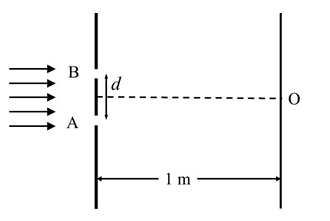
The maximum speed in $$\mu$$ m/s at which the $$8^{th}$$ bright fringe will move is ________.
Correct Answer: 24.00
For the 8th bright fringe in Young’s double-slit experiment, the instantaneous position on the screen is
$$y_m(t)=\frac{m\lambda D}{d(t)}$$
with $$m=8,\;D=1\text{ m},\;\lambda =6000\text{ \AA}=6\times10^{-7}\text{ m}$$ and
$$d(t)=\bigl(0.8+0.04\sin\omega t\bigr)\text{ mm} =(8\times10^{-4}+4\times10^{-5}\sin\omega t)\text{ m},\qquad \omega =0.08\text{ rad s}^{-1}$$
The speed of this fringe is obtained by differentiating:
$$v(t)=\frac{dy_m}{dt} =-\frac{m\lambda D}{\bigl[d(t)\bigr]^2}\,\frac{dd}{dt}$$
First derivative of the slit separation:
$$\frac{dd}{dt}=4\times10^{-5}\;\omega\cos\omega t =4\times10^{-5}\times0.08\cos\omega t =3.2\times10^{-6}\cos\omega t\;(\text{m s}^{-1})$$
Hence
$$v(t)=\frac{8\,(6\times10^{-7})(3.2\times10^{-6})\, |\cos\omega t|}{\bigl(8\times10^{-4}+4\times10^{-5}\sin\omega t\bigr)^2}$$
To find the maximum value, put $$\theta=\omega t$$ and maximise
$$f(\theta)=\frac{|\cos\theta|} {\bigl(a+b\sin\theta\bigr)^2},\qquad a=8\times10^{-4},\;b=4\times10^{-5}$$
Within $$0\le\theta\lt2\pi$$, choose the region $$\cos\theta\gt0$$ (same magnitude repeats elsewhere).
Set $$\displaystyle\frac{d}{d\theta}\ln f(\theta)=0$$:
$$-\tan\theta-\frac{2b\cos\theta}{a+b\sin\theta}=0$$
After simplification, using $$x=\sin\theta$$:
$$b x^{2}-a x-2b=0$$
Substituting $$a=8\times10^{-4},\;b=4\times10^{-5}$$ gives
$$x^{2}-20x-2=0\; \Longrightarrow\; x=\sin\theta\approx-0.0995$$
With this $$\cos\theta=\sqrt{1-x^{2}}\approx0.995$$ and
$$d_{\text{max}}=a+b\sin\theta =8\times10^{-4}+4\times10^{-5}(-0.0995) \approx7.960\times10^{-4}\text{ m}$$
Finally, the maximum fringe speed is
$$v_{\max} =\frac{8(6\times10^{-7})(3.2\times10^{-6})(0.995)} {(7.960\times10^{-4})^{2}} \approx2.4\times10^{-5}\text{ m s}^{-1}$$
Expressing in micrometres per second:
$$v_{\max}\approx2.4\times10^{-5}\text{ m s}^{-1} =24\text{ }\mu\text{m s}^{-1}$$
Therefore, the maximum speed of the 8th bright fringe is 24 μm/s.
Was this solution helpful?
Create a FREE account and get:
_1.webp)

Educational materials for JEE preparation

Ask our AI anything

AI can make mistakes. Please verify important information.
AI can make mistakes. Please verify important information.
