
Join Our JEE Preparation Group
Prep with like-minded aspirants; Get access to free daily tests and study material.
Sign in
Please select an account to continue using cracku.in
↓ →
Join Our JEE Preparation Group
Prep with like-minded aspirants; Get access to free daily tests and study material.
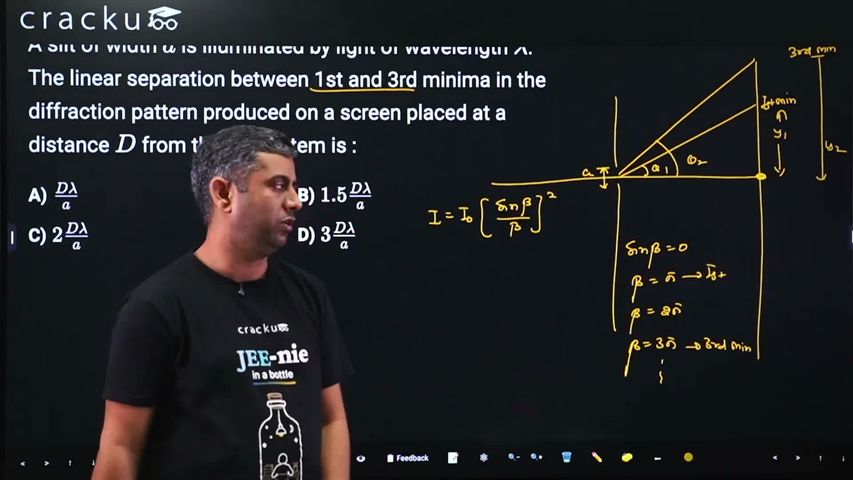
A slit of width $$a$$ is illuminated by light of wavelength $$\lambda$$. The linear separation between 1st and 3rd minima in the diffraction pattern produced on a screen placed at a distance $$D$$ from the slit system is :
For a single-slit Fraunhofer diffraction pattern the angular position of the $$m^{\text{th}}$$ minimum is given by the condition
$$a \sin\theta_m = m\lambda, \qquad m = 1,2,3,\dots$$
Here $$a$$ is the slit width and $$\lambda$$ is the wavelength of the light.
When the screen is at a large distance $$D$$, the linear distance $$y_m$$ of the $$m^{\text{th}}$$ minimum from the central axis is obtained using the small-angle approximation $$\sin\theta_m \approx \tan\theta_m \approx \theta_m$$:
$$y_m = D \tan\theta_m \approx D \theta_m = D \sin\theta_m = D \left(\frac{m\lambda}{a}\right) = \frac{m\lambda D}{a}$$
Thus,
for the first minimum $$\bigl(m = 1\bigr): \; y_1 = \frac{\lambda D}{a}$$
for the third minimum $$\bigl(m = 3\bigr): \; y_3 = \frac{3\lambda D}{a}$$
The required linear separation between the first and third minima is
$$y_3 - y_1 = \frac{3\lambda D}{a} - \frac{\lambda D}{a} = \frac{2\lambda D}{a}$$
Hence the correct choice is:
Option C which is: $$\frac{2D\lambda}{a}$$
Was this solution helpful?
Click on the Email ☝️ to Watch the Video Solution
Create a FREE account and get:
_1.webp)

Educational materials for JEE preparation

Ask our AI anything

AI can make mistakes. Please verify important information.
AI can make mistakes. Please verify important information.


