
Join Our JEE Preparation Group
Prep with like-minded aspirants; Get access to free daily tests and study material.
Sign in
Please select an account to continue using cracku.in
↓ →
Join Our JEE Preparation Group
Prep with like-minded aspirants; Get access to free daily tests and study material.
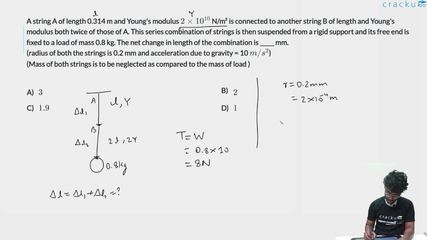
A string A of length 0.314 m and Young's modulus $$2 \times 10^{10}$$ N/m² is connected to another string B of length and Young's modulus both twice of those of A. This series combination of strings is then suspended from a rigid support and its free end is fixed to a load of mass 0.8 kg. The net change in length of the combination is _____ mm.
(radius of both the strings is 0.2 mm and acceleration due to gravity = 10 $$m/s^{2}$$)
(Mass of both strings is to be neglected as compared to the mass of load )
The extension of a uniform string under a steady load is obtained from
$$\Delta L = \dfrac{F\,L}{A\,Y}$$
where $$F$$ is the tension (equal to the load’s weight), $$L$$ is the original length, $$A$$ is the cross-sectional area and $$Y$$ is Young’s modulus.
Data for the two strings
String A: $$L_1 = 0.314\ \text{m},\quad Y_1 = 2 \times 10^{10}\ \text{N m}^{-2}$$
String B: $$L_2 = 2L_1 = 0.628\ \text{m},\quad Y_2 = 2Y_1 = 4 \times 10^{10}\ \text{N m}^{-2}$$
Common radius: $$r = 0.2\ \text{mm} = 0.2 \times 10^{-3}\ \text{m}$$
Cross-sectional area of either string:
$$A = \pi r^{2} = \pi\,(0.2 \times 10^{-3})^{2}$$
$$A = \pi \times 0.04 \times 10^{-6} = 4\pi \times 10^{-8}\ \text{m}^{2}$$
Load attached at the lower end:
$$m = 0.8\ \text{kg},\quad g = 10\ \text{m s}^{-2}$$
$$F = mg = 0.8 \times 10 = 8\ \text{N}$$
Extension of String A
$$\Delta L_1 = \dfrac{F\,L_1}{A\,Y_1}
= \dfrac{8 \times 0.314}{(4\pi \times 10^{-8})\,(2 \times 10^{10})}$$
Denominator: $$4\pi \times 10^{-8} \times 2 \times 10^{10} = 8\pi \times 10^{2} = 800\pi$$
Hence
$$\Delta L_1 = \dfrac{2.512}{800\pi}\ \text{m}
\approx 0.000999\ \text{m} = 0.999\ \text{mm}$$
Extension of String B
$$\Delta L_2 = \dfrac{F\,L_2}{A\,Y_2}
= \dfrac{8 \times 0.628}{(4\pi \times 10^{-8})\,(4 \times 10^{10})}$$
Denominator: $$4\pi \times 10^{-8} \times 4 \times 10^{10} = 16\pi \times 10^{2} = 1600\pi$$
So
$$\Delta L_2 = \dfrac{5.024}{1600\pi}\ \text{m}
\approx 0.000999\ \text{m} = 0.999\ \text{mm}$$
Total extension of the series combination
$$\Delta L_{\text{total}} = \Delta L_1 + \Delta L_2
\approx 0.999\ \text{mm} + 0.999\ \text{mm}
\approx 1.998\ \text{mm}$$
Rounded to the nearest millimetre, the net change in length is $$2\ \text{mm}$$.
Option B which is: $$2$$
Was this solution helpful?
Click on the Email ☝️ to Watch the Video Solution
Create a FREE account and get:
_1.webp)

Educational materials for JEE preparation

Ask our AI anything

AI can make mistakes. Please verify important information.
AI can make mistakes. Please verify important information.


