
Join Our JEE Preparation Group
Prep with like-minded aspirants; Get access to free daily tests and study material.
Sign in
Please select an account to continue using cracku.in
↓ →
Join Our JEE Preparation Group
Prep with like-minded aspirants; Get access to free daily tests and study material.
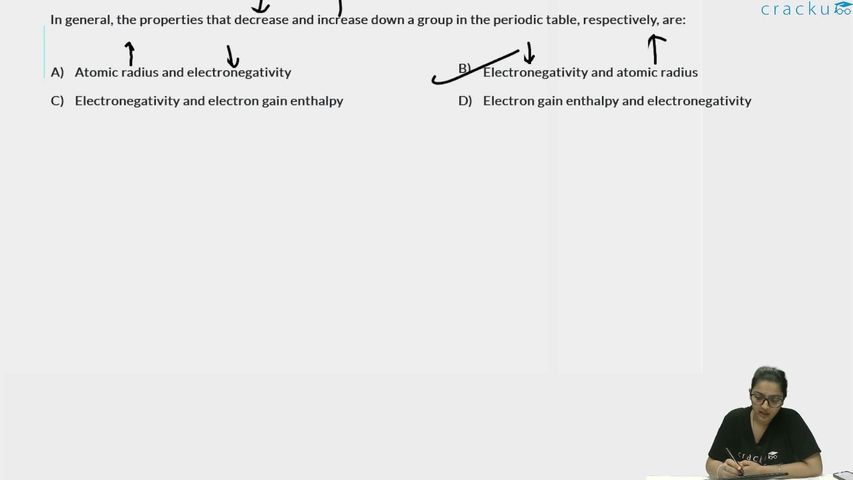
In general, the properties that decrease and increase down a group in the periodic table, respectively, are:
First, we recall the basic periodic trends that are always examined in questions of this type. Down any family (that is, as we proceed from the top of a vertical column of the periodic table to the bottom) two of the most routinely discussed properties are the atomic (or ionic) radius and the electronegativity.
We start with the atomic radius. As we go from one period to the next period directly below it, one extra principal quantum shell $$n$$ is added. Because the quantum number $$n$$ appears in the Bohr‐type relation $$r \propto n^{2}$$ and also simply counts the number of shells, the size of the electron cloud increases. The inner shells shield the outermost electrons from the full nuclear charge, so the effective nuclear attraction on the valence shell does not grow enough to contract the atom. Hence, the net effect is that the atomic radius increases down a group:
$$\text{Down a group: } r_{\text{atomic}} \uparrow$$
Now we examine electronegativity, the tendency of an atom to attract a shared electron pair toward itself in a covalent bond. A commonly quoted relation for Pauling electronegativity is
$$\chi = \dfrac{A + B}{2} - \sqrt{\Delta},$$
where $$\chi$$ decreases when the atomic size becomes large and the nuclear pull on bonding electrons becomes weaker. Because we have just reasoned that the radius increases down the group, the nucleus is farther away from bonding electrons and, additionally, inner‐shell shielding further reduces the effective nuclear charge. Consequently, the ability to attract bonding electrons decreases down a group:
$$\text{Down a group: } \chi_{\text{electronegativity}} \downarrow$$
Putting these two well-established facts together, we see that one property (electronegativity) decreases while the other (atomic radius) increases as we descend a group.
We now compare this conclusion with the given alternatives:
A. Atomic radius and electronegativity — this would mean radius decreases and electronegativity increases, which contradicts the observed trend.
B. Electronegativity and atomic radius — this states exactly what we derived: electronegativity decreases while atomic radius increases.
C. Electronegativity and electron gain enthalpy — electron gain enthalpy also becomes less negative (i.e., decreases) down a group, not increases, so the second part does not match.
D. Electron gain enthalpy and electronegativity — this implies electron gain enthalpy decreases and electronegativity increases, both of which are opposite to fact.
Therefore, the only option consistent with the proven periodic trends is Option B, which is numbered 2 in the question.
Hence, the correct answer is Option 2.
Was this solution helpful?
Click on the Email ☝️ to Watch the Video Solution
Create a FREE account and get:
_1.webp)

Educational materials for JEE preparation

Ask our AI anything

AI can make mistakes. Please verify important information.
AI can make mistakes. Please verify important information.
