
Join Our JEE Preparation Group
Prep with like-minded aspirants; Get access to free daily tests and study material.
Sign in
Please select an account to continue using cracku.in
↓ →
Join Our JEE Preparation Group
Prep with like-minded aspirants; Get access to free daily tests and study material.
Oxidation number of potassium in K$$_2$$O, K$$_2$$O$$_2$$ and KO$$_2$$, respectively, is:
First, we recall the fundamental rule for any electrically neutral compound: the algebraic sum of the oxidation numbers of all the atoms present is always equal to zero. We write this rule as $$\text{Sum of all oxidation numbers}=0.$$ We apply this idea one compound at a time.
We start with potassium oxide, $$\mathrm{K_2O}.$$ In ordinary oxides, oxygen always carries the oxidation number $$-2.$$ Let the oxidation number of potassium be $$x.$$ The formula contains two potassium atoms and one oxygen atom, so we write the sum:
$$2\,x + (-2) = 0.$$
Now we isolate $$x$$ by shifting $$-2$$ to the other side:
$$2\,x = +2.$$
Dividing both sides by $$2,$$ we obtain
$$x = +1.$$
Hence, in $$\mathrm{K_2O}$$ each potassium atom has oxidation number $$+1.$$
Next, we examine potassium peroxide, $$\mathrm{K_2O_2}.$$ In a peroxide ion $$\left(\mathrm{O_2^{2-}}\right),$$ each oxygen possesses oxidation number $$-1.$$ Again let the oxidation number of potassium be $$x.$$ The compound has two potassium atoms and two oxygen atoms, therefore
$$2\,x + 2\,(-1) = 0.$$
Multiplying out the terms we have
$$2\,x - 2 = 0.$$
Adding $$2$$ on both sides gives
$$2\,x = +2.$$
Dividing by $$2$$ yields
$$x = +1.$$
Thus, in $$\mathrm{K_2O_2}$$ also, each potassium atom carries oxidation number $$+1.$$
Finally, we turn to potassium superoxide, $$\mathrm{KO_2}.$$ A superoxide ion $$\left(\mathrm{O_2^{-}}\right)$$ bears an overall charge of $$-1,$$ so the average oxidation number of each oxygen is $$-\dfrac12.$$ Denote the oxidation number of potassium by $$x.$$ The formula contains one potassium atom and two oxygen atoms, so the sum statement becomes
$$x + 2\left(-\dfrac12\right) = 0.$$
Simplifying the product $$2\left(-\dfrac12\right)$$ we get $$-1,$$ hence
$$x - 1 = 0.$$
Adding $$1$$ to both sides gives
$$x = +1.$$
Consequently, in $$\mathrm{KO_2}$$ the oxidation number of potassium is again $$+1.$$
We have now determined the oxidation numbers of potassium in all three compounds:
$$\mathrm{K_2O} : +1,\qquad \mathrm{K_2O_2} : +1,\qquad \mathrm{KO_2} : +1.$$
These values correspond exactly to the pattern given in Option B.
Hence, the correct answer is Option B.
Was this solution helpful?
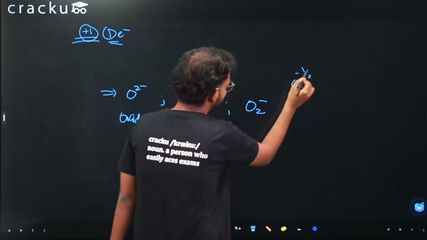
Click on the Email ☝️ to Watch the Video Solution
Create a FREE account and get:
_1.webp)

Educational materials for JEE preparation

Ask our AI anything

AI can make mistakes. Please verify important information.
AI can make mistakes. Please verify important information.


